

The Silent Bedroom · Article 14 of 18
Eight months
Call them Suresh and Lakshmi. Their marriage in Coimbatore was arranged; they met three times before the wedding, always with family present. On the wedding night they were both exhausted and frightened. When Suresh tried to begin intercourse, Lakshmi tensed with pain, and Suresh, panicking, ejaculated before he could enter her. They tried again the next night, and the next. Each attempt went the same way.
Eight months later the marriage was still unconsummated. Each privately blamed themselves. Suresh was convinced his speed was the problem; Lakshmi believed something was wrong with her body. Neither said so. Suresh went alone to a clinic and was given tablets to delay ejaculation. They helped him last a little longer, but Lakshmi’s pain was unchanged, and attempts became even more fraught. Lakshmi went alone to a gynaecologist who told her she was normal and needed to relax.
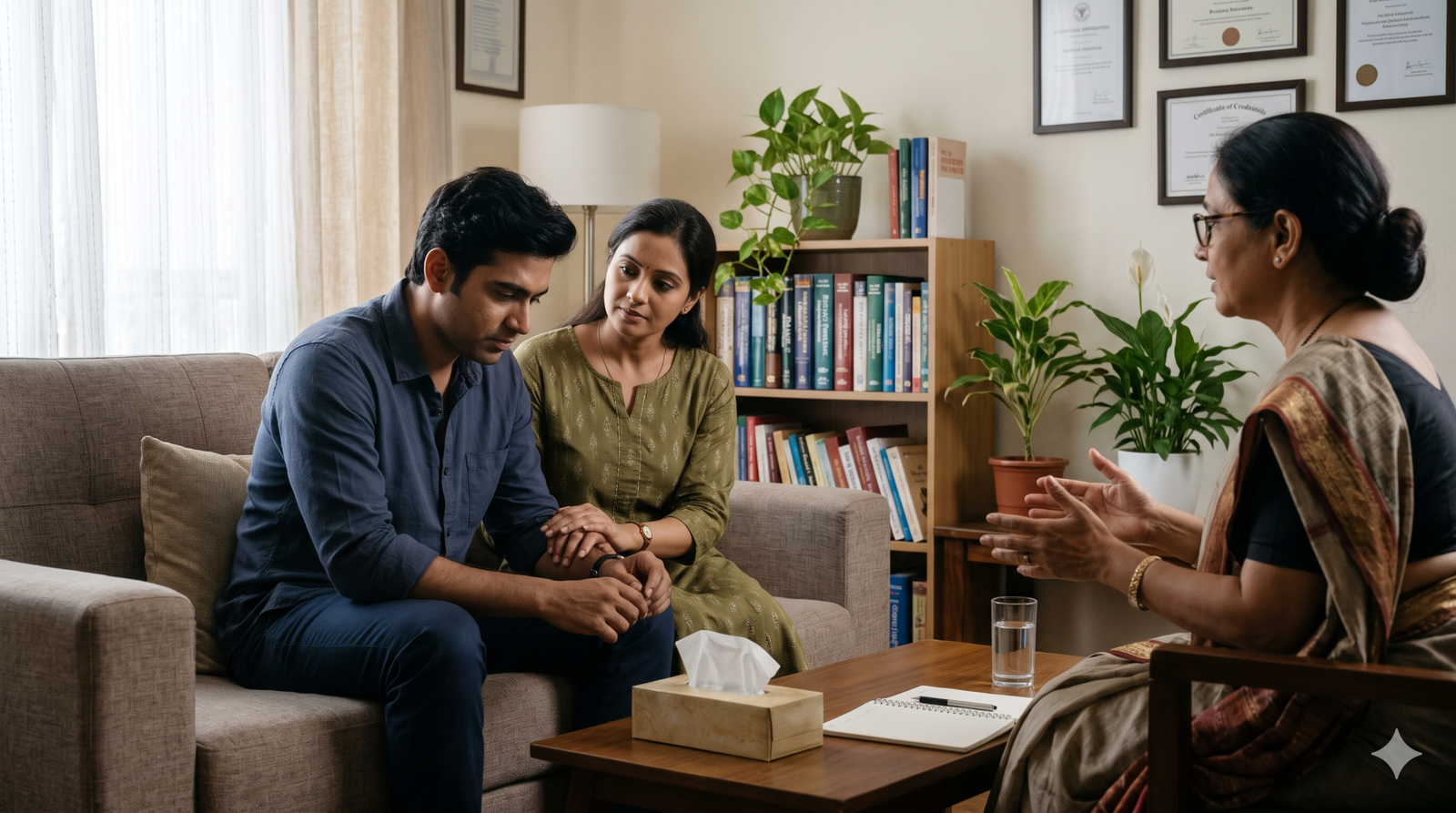
It was a family doctor, finally, who suggested they see a sex therapist together. In the first session the therapist explained that Lakshmi’s pain and involuntary tightening and Suresh’s rapid ejaculation were feeding each other: her fear made penetration painful, his panic at her pain made him finish instantly, and each failure deepened both fears. Over three months they worked together on touch without any attempt at intercourse, on gradual exercises for Lakshmi, and on talking. The marriage was consummated in the eleventh month. What finally worked was not treating him, or her, but them.
Suresh and Lakshmi are composites.
The core question
This series has mostly been about men: their bodies, minds, histories, households and fears. That focus reflects how Indian medicine and Indian culture approach sexual problems. A man with erectile difficulty or premature ejaculation goes to a clinic alone, is examined alone, is given tablets alone and goes home to a wife who often does not know he went.
Yet sex, in a marriage, is something two people do together. Masters and Johnson, who founded modern sex therapy, insisted on treating couples rather than individuals, on the principle that there is no such thing as an uninvolved partner. Each partner’s body, fears and responses shape the other’s. A man’s anxiety affects his wife’s arousal; her pain or reluctance affects his confidence; his avoidance feeds her sense of rejection; her silence leaves him guessing. What looks like one person’s dysfunction is very often a pattern between two.
This essay asks what follows from taking that seriously in India, where most couples begin married life as near-strangers, where women’s sexual difficulties are even less discussed than men’s, and where couples therapy is rare. It argues that the most effective unit of treatment is usually the couple, and that the most important resource a couple has is the relationship itself.
The evidence on how partners’ difficulties interlock, and on couple-based treatment, is reasonably strong though largely Western. Indian data on marriage patterns are established. The application to Indian couples draws on a smaller body of Indian clinical research and is partly interpretive.
Strangers on the first night
Most Indian marriages still begin with two people who barely know each other. In the India Human Development Survey of 2011-12, 73% of women said their parents or relatives alone had chosen their husbands, only 5% said they had chosen entirely by themselves, and 65% said they had met their husband for the first time on the wedding day, from 94% in Bihar to none in Manipur (IndiaSpend). A 2018 survey by the Lok Foundation and Oxford University found that 93% of married respondents described their marriages as arranged (Countercurrents). The practice is changing rather than disappearing: researchers describe a shift towards marriages that families arrange but in which young women have more say and couples are more likely to meet beforehand (same source). Even so, in a recent UDAYA study of newly married young women in Uttar Pradesh and Bihar, a quarter had met their husbands for the first time on their wedding day (Social Science & Medicine).
Arranged marriages are not doomed to be unhappy. A small study of Indian couples living in the United States found no differences between arranged and love marriages in satisfaction, commitment or passionate love (Regan et al., 2012), though critics pointed out that its sample was too small to settle the question (Johnson & Bachan, 2013). Another study found that what mattered most was not the type of marriage but how much influence women felt they had over the choice: women with more say reported more intimacy, passion and commitment (Semantic Scholar summary).
The distinctive challenge of the arranged marriage is sequence. In a love marriage, intimacy usually grows before sex: two people learn each other’s moods, humour and comfort first. In a traditional arranged marriage, sex is expected first, often on the first night, and intimacy is meant to follow. “Love comes after marriage” is a common Indian saying, and often a true one. But it means that many couples attempt the most vulnerable act of their relationship before any trust exists, under the gaze of a family waiting for news. Suresh and Lakshmi were not unusual. They were simply two frightened strangers asked to perform intimacy before they had built any.
Two bodies, one problem
The clearest evidence that sexual problems belong to couples comes from the most extreme case: the marriage that is never consummated. Clinicians in India see such marriages far more often than their Western counterparts, because most Indian couples have no sexual experience before marriage, as an Indian andrology team noted (Krishnappa et al., 2023). A 2024 systematic review of 27 studies, covering more than 1,600 men and nearly 1,600 women, found that the most common causes were vaginismus, an involuntary tightening of the vaginal muscles that makes penetration painful or impossible, and erectile dysfunction. In studies that examined both partners, between 16.6% and 26% of cases were due to problems in both of them at once, and the authors stressed a strong psychological component and the need for treatment combining education, medical care and psychosexual support (Journal of Sexual Medicine). In one large series of 769 couples with unconsummated marriages, the primary problem was vaginismus in 371, premature ejaculation in 258 and erectile dysfunction in 140 (PMC).
Where a couple’s difficulty is first seen shapes how it is labelled. In that andrology clinic, which saw men, 90% of the 62 men who came with unconsummated marriages described erectile dysfunction as the cause; only a handful mentioned their wife’s pain. The team involved the female partner where possible and referred women for their own assessment (Krishnappa et al.). A gynaecology clinic seeing the same couples might have labelled them as cases of vaginismus. Suresh and Lakshmi had both labels, and neither was the whole truth.
The interlocking continues long after the first night. In the international FEMALES study of 293 women whose partners had developed erectile dysfunction, women reported having sex less often, and fewer reported regular desire, arousal or orgasm, after their partner’s problem began; the decline in their satisfaction tracked the severity of his difficulty (Fisher et al., 2005). In a randomised trial, women whose partners received an erectile dysfunction medicine showed improvements in their own desire, arousal, orgasm and satisfaction, even though the women themselves had received no treatment, and their gains tracked their partners’ (Goldstein et al., 2005). The previous essays reported the same pattern for premature ejaculation, with partners of affected men far more likely to have sexual difficulties of their own.
The traffic runs both ways. A woman’s pain, anxiety or lack of arousal can make her partner anxious, rushed or unable to maintain an erection, just as his difficulties can dampen her desire and arousal. In Suresh and Lakshmi’s case, her fear of pain and his fear of failure locked together so tightly that treating either alone could not release them. That is what Masters and Johnson meant: in a couple, there is no uninvolved partner.
What feeds desire between two people
If sexual problems are shared, so are the resources for overcoming them. Research on what sustains desire in couples points less to technique than to the quality of the connection.
The most important single factor may be responsiveness: the sense that one’s partner understands, values and cares for one’s needs. In a series of experiments, the psychologists Gurit Birnbaum, Harry Reis and colleagues found that sexual desire increased when a partner was perceived as, or actually was, more emotionally responsive, an effect especially marked in women (Birnbaum et al., 2016; Frontiers review). In a 21-day diary study of 67 couples, days on which intimacy increased were followed by more passion, a greater likelihood of having sex and greater sexual satisfaction, with no difference between men and women (Rubin & Campbell, 2012, discussed; van Lankveld et al.). A later replication found that the relationship ran both ways: intimacy fed passion, and passion fed intimacy (Aykutoğlu & Uysal, 2017).
Research also suggests that why couples have sex matters. Sex sought for closeness or pleasure tends to sustain desire and satisfaction over time, while sex undertaken to avoid conflict or disappointment is linked to poorer outcomes (review citing Impett et al.). That has obvious relevance to couples who have sex out of duty, to produce a child on schedule, or to prove that nothing is wrong.
Indian evidence hints that couples in arranged marriages may rely less on explicit communication for their overall satisfaction. An older comparative study found that in Indian love marriages, as in American marriages, verbal, non-verbal and sexual communication strongly shaped satisfaction, whereas in Indian arranged marriages it mattered less (Yelsma & Athappilly, as summarised); a more recent study of Indian couples with sexual dysfunction made a similar observation, crediting commitment and family support (Manjula et al., 2021). That is a real strength of many Indian marriages: they can survive a great deal. But surviving is not the same as thriving, and when sexual problems arise, the same reluctance to talk can leave couples stuck.
The interpretation. For couples who begin as strangers, the research offers a hopeful message. Desire is not a fixed quantity that a couple either has on the first night or lacks for ever. It can be grown, and it grows from ordinary acts of attention: listening, noticing, responding, making the other person feel understood. A husband anxious about his performance in bed might do more for their sex life by being responsive out of bed than by any technique. “Love comes after marriage” is not just a hope; it describes a process that can be deliberately nurtured.
The couple’s dance
The pattern that trapped Suresh and Lakshmi can be drawn as a sequence in which each partner’s reaction sets off the other’s. No single step is anyone’s fault, and no single step, treated alone, breaks the cycle.

Other couples dance different steps: his erectile difficulty and her loss of desire, his avoidance and her feeling unwanted, her exhaustion and his frustration. The shape is the same. Each person’s distress becomes the other person’s trigger, and the way out lies in changing the dance together.
Treating the couple
If sexual problems are shared, the logical response is to treat them together. The evidence broadly supports this, with important qualifications.
Psychological treatments for sexual problems work. A meta-analysis of 20 randomised trials comparing psychological interventions with waiting lists found moderate improvements in symptom severity and in sexual satisfaction, with the strongest effects for women’s low desire and difficulty with orgasm (Frühauf et al., 2013). The evidence for psychological treatment of premature ejaculation alone was weaker and less consistent (summary), which is one reason guidelines now favour combining it with medication rather than choosing one or the other. For erectile dysfunction, a Cochrane review found that group therapy combined with sildenafil worked better than sildenafil alone (Cochrane). And as the fourth section showed, simply treating a man’s erectile problem tends to improve his partner’s sexual life too.
For unconsummated marriages, couple-based treatment appears especially effective. At one American sexual health clinic, a programme for 20 couples combined education about the body, gradual dilator exercises with mindfulness for the woman, and assignments for both partners in non-sexual and sexual intimacy; 90% achieved intercourse within six months, and the rest were referred for marital therapy (Henry Ford Health). A systematic review recommended a similar combination of sex education, medical treatment and psychosexual support for both partners (Journal of Sexual Medicine). Treatments for vaginismus based on gradual, therapist-guided exposure have been tested in randomised trials (ter Kuile et al., 2013).
Access remains the obstacle. India has relatively few trained sex therapists, couples therapy is expensive and concentrated in large cities, and many urologists and gynaecologists still see only one partner. One partial answer may be online help: a meta-analysis of 11 trials of internet- and app-based psychological programmes for sexual problems found them effective, particularly for women’s sexual function, though many participants did not finish them (npj Digital Medicine). For couples who cannot reach a therapist, structured self-help used together may be better than nothing, and far better than a remedy bought in secret.
The core of most couple-based sex therapy is simple to describe, if not always easy to do. Couples agree to stop attempting intercourse for a while, removing the source of fear. They practise touching each other in stages, without any goal of arousal or orgasm, gradually rediscovering pleasure without pressure. Each partner’s specific difficulty is treated alongside, with medication, exercises or individual help. And they learn to talk, about what feels good, what frightens them and what they want. It is, in effect, a deliberate way of building the intimacy that arranged marriages expect to arrive on its own.
How it shows up in the bedroom
The first pattern is parallel shame. Each partner privately believes they are the cause, and neither says so. He thinks his speed or softness is ruining their marriage; she thinks her body or her lack of desire is to blame. Both suffer, and each tries to protect the other by staying silent, which guarantees that the real pattern is never seen.
The second is the one-sided treatment. One partner seeks help, usually alone and often in secret, and returns with tablets or advice that address only half the problem. When the other half persists, the treatment seems to have failed, and both lose hope.
The third is the slow drift. A couple whose first attempts at sex went badly may simply stop trying. Months become years. They remain affectionate, raise children if they can conceive, and describe their marriage to others as fine. The sexual relationship becomes a closed room neither of them enters.
The fourth is blame. In some marriages, the frustration turns outward. He accuses her of being cold; she accuses him of being inadequate; families take sides. The sexual problem becomes a battleground, and the original difficulty is buried under resentment.
The fifth is the couple who turn towards each other. They name the problem as theirs rather than his or hers, seek help together, and treat the work of rebuilding their sexual life as a project they share. These couples tend to do well, not because their problems were smaller, but because they faced them as two people rather than one.
Counterpoints and limits
Not every sexual problem is relational. Some are largely biological: erectile dysfunction caused by diabetes or vascular disease, lifelong premature ejaculation, hormonal problems, or a woman’s pain caused by a medical condition. These need medical diagnosis and treatment, and calling them “couple problems” must never become a reason to skip a check-up. The couple framework adds to medical care; it does not replace it.
Couple therapy is not always appropriate or safe. Where there is violence, coercion or severe conflict, joint sessions can put a partner at risk, and individual help comes first. Not every marriage should be preserved at all costs, and some partners, having faced their difficulties honestly, decide to separate.
Much of the evidence is Western, and Indian marriages differ in ways that matter: the role of extended families, the low acceptability of discussing sex, the scarcity of therapists and the economic dependence of many wives. Interventions designed for American or European couples may need adapting to work in India.
This essay has focused on married heterosexual couples, because that is where most Indian sexual life is lived and where most clinical data come from. Unmarried couples and same-sex couples face their own versions of these patterns, often with even less support, and deserve attention that this series has only touched on.
Finally, the idea that a sexual problem belongs to the couple is not a way of shifting blame onto women. In Suresh and Lakshmi’s case, neither was to blame. The point is that both were affected, both contributed to the pattern without meaning to, and both were needed to change it.
What it means
For couples, the most important shift is in language: from “my problem” or “your problem” to “our problem”. That change alone can lift a great deal of shame, because it means neither partner is on trial. From there, practical steps follow. Agree to take intercourse off the table for a while if it has become a source of fear. Spend time touching without any goal. Talk outside the bedroom about what each of you finds difficult and what each enjoys. And if things do not improve, seek help together.
For newly married couples, especially in arranged marriages, it is worth remembering that there is no deadline. The family may be waiting for news, but intimacy built slowly is more durable than intercourse achieved under pressure. Spending the first weeks getting to know each other, talking, touching and laughing before attempting sex is not a failure. It is how the most successful arranged marriages have always worked.
For families, the kindest thing is to stop asking. Questions about “good news”, hints about a grandchild, and comments on the couple’s closeness add pressure to the most fragile part of a new marriage. If a couple are struggling, the most useful thing a family can do is to support them in seeking help, without demanding details.
For clinicians, the lesson is to see both partners. A urologist treating a man for premature ejaculation or erectile difficulty should ask about his wife’s experience, and invite her if he agrees. A gynaecologist seeing a woman with pain should ask about her husband’s function and his response. Referring couples together to a qualified sex therapist or counsellor, and treating both partners’ difficulties at the same time, offers the best chance of breaking the pattern.
For health systems and medical schools, training more professionals in couple-based sexual health, and encouraging urologists, gynaecologists and psychiatrists to work together, would give many more Indian couples the kind of help that Suresh and Lakshmi eventually found.
Key takeaways
In a marriage there is no uninvolved partner: each person’s body, fears and responses shape the other’s, and what looks like one partner’s dysfunction is often a pattern between two. Most Indian marriages are still arranged, and in national surveys about two-thirds of women met their husbands for the first time on their wedding day, so many couples attempt the most vulnerable act of their relationship before trust exists. Arranged marriages can be as satisfying as love marriages, especially when women have a say in the choice, and research shows that responsiveness and growing intimacy feed desire, so love that comes after marriage can be deliberately nurtured. Unconsummated marriages, more common in India than in the West, are usually caused by vaginismus or erectile difficulty and sometimes by problems in both partners; men’s erectile dysfunction and premature ejaculation are linked to their partners’ sexual difficulties, and treating the man often helps the woman too. Psychological and couple-based treatments are effective, especially combined with medical care, and most unconsummated marriages can be resolved with education, gradual exercises, intimacy-building and support for both partners. Access in India remains limited, some problems are mainly biological and some relationships are unsafe for joint therapy, but for most couples the best treatment is the one they undertake together.
Sources and further reading
Marriage in India
- Only 5% of Indian women have sole control over choosing their husband, IndiaSpend (IHDS)
- IHDS partner choice map
- Indian Matchmaking: decoding India’s love affair with arranged marriages, Countercurrents
- Marital choice and spousal communication among newly married girls, UDAYA, Social Science & Medicine
- Regan et al., Relationship outcomes in Indian-American love-based and arranged marriages (2012)
- Johnson and Bachan, comment on small sample sizes (2013)
- Regan et al. (2012) and related work on influence over partner selection, Semantic Scholar
- Yelsma and Athappilly, as summarised in a comment on arranged marriage research
- Manjula et al., Marital relationship and sexual interaction in Indian couples with sexual dysfunction (2021)
Unconsummated marriage and interlocking difficulties
- Unconsummated marriage: a systematic review, Journal of Sexual Medicine (2024)
- Krishnappa et al., Unconsummated marriage in an Indian andrology clinic (2023)
- Fertility outcomes in 769 couples with unconsummated marriages
- Fisher et al., The FEMALES study of partners of men with erectile dysfunction (2005)
- Goldstein et al., Women’s sexual function improves when partners are treated for erectile dysfunction (2005)
- Dean et al., Integrating partners into erectile dysfunction treatment (2008)
Desire and intimacy
- Birnbaum et al., Partner responsiveness and sexual desire (2016)
- Intimacy, partner responsiveness and attachment needs, Frontiers in Psychology
- Aykutoğlu and Uysal, Intimacy change and passion: a dyadic diary study (2017)
- van Lankveld et al., The associations of intimacy and sexuality in daily life (2018)
- Review of gendered patterns of sexual pleasure, citing work on sexual motives
Treatment
- Frühauf et al., Efficacy of psychological interventions for sexual dysfunction: a meta-analysis (2013)
- Evaluation of Frühauf et al. on premature ejaculation
- Cochrane review: psychosocial interventions for erectile dysfunction
- Consummating the unconsummated marriage, Henry Ford Health
- Sexual dysfunctions chapter citing ter Kuile et al. on vaginismus
- Internet- and mobile-based psychological interventions for sexual dysfunctions: a meta-analysis, npj Digital Medicine
Disclaimer: This content is for general information only and does not replace professional medical advice. Asmidev is not responsible for any diagnosis made based on this content, nor does it endorse or take responsibility for external websites or products mentioned. Always consult a qualified healthcare professional for health-related concerns. This article was created through a human–AI collaboration. The ideas and direction come from the author’s research, with AI used only to assist in organizing information and refining expression, while cross-checking against established scientific literature.


