


The Silent Bedroom · Article 9 of 18
The stopwatch
Arjun is twenty-seven, a software engineer in Pune, married for a year. One night, without telling his wife, he started the stopwatch on his phone before they began, and checked it afterwards. Four minutes and some seconds. He did this, secretly, several more times. The number never went much above five.
Arjun was devastated. In his engineering hostel, men had boasted of lasting half an hour. The videos he had watched since his teens seemed to go on for ever. The advertisements on his social media feed promised “lasting power” and “timing” in capsule form. He ordered a numbing spray online, which dulled his own sensation without changing much else, then a box of herbal tablets whose ingredients he could not pronounce.
His wife had never complained. When he finally confessed his worry, half expecting her to agree, she looked puzzled. What bothered her, she said after a long pause, was something else: that he seemed somewhere far away during sex, as if concentrating on a problem, and that afterwards he turned over in silence.
Arjun went to a urologist, determined to get a prescription. He wanted to know how he could reach thirty minutes. The doctor’s first question surprised him: who had told him thirty minutes was normal?
Arjun is a composite.
The core question
The first essay in this series noted that the rate of premature ejaculation among Indian men is roughly in line with the rest of the world, but that the distress around it is unusually high. This essay, the first of four on patriarchy and premature ejaculation, asks why. Its argument is that much of that distress has little to do with ejaculation itself and a great deal to do with a clock: an imagined standard of how many minutes a “real man” should last, which very few men meet and very few women actually want.
The clock did not fall from the sky. It is the product of a particular idea of sex, in which intercourse is the main event, the man is responsible for its success, and success is measured by how long he can hold out. That idea is patriarchal in a precise sense. It places the man at the centre of sex, makes his performance the measure of the encounter, and treats a woman’s pleasure as something he produces through endurance rather than something two people discover together.
As in earlier essays, the evidence is signalled as we go. The figures on timing come from established international studies using stopwatches. The findings on what women want rest on surveys and experiments that are reasonably strong but mostly Western. The argument that the clock is a patriarchal invention is an interpretation, built on that evidence and on the history traced in Part III.
What the numbers actually say
Premature ejaculation is a real condition, and it has a careful definition. The International Society for Sexual Medicine defines it by three elements that must all be present. The first is time: ejaculation that always or nearly always happens before or within about one minute of penetration, from a man’s first sexual experiences (lifelong premature ejaculation), or a clear and bothersome drop in timing, often to about three minutes or less, in a man who previously lasted longer (acquired premature ejaculation). The second is control: being unable to delay ejaculation on all or nearly all occasions. The third is consequence: distress, frustration or avoidance of intimacy (ISSM unified definition, 2014; summary table). By that definition, the condition is far less common than most men assume. Reviewing the evidence, the committee estimated that about 2 to 3% of men have the lifelong form and about 4% of sexually active men the acquired form (NBC News).
What, then, is normal? The best answer comes from the Dutch psychiatrist Marcel Waldinger and colleagues, who asked 500 couples in five countries to time intercourse with a stopwatch over four weeks. The median time from penetration to ejaculation was 5.4 minutes, with an enormous range, from about half a minute to 44 minutes (Waldinger et al., 2005). It also fell with age, from 6.5 minutes in men aged 18 to 30 to 4.3 minutes in men over 50 (summary). A second survey, using a blinded electronic timer so that men could not watch the clock, found a median of 6.0 minutes, ranging from 4.4 minutes in Turkey to 10 minutes in the United Kingdom. Tellingly, men who said they were unhappy with how long they lasted had a median of 5.2 minutes, barely different from everyone else (Waldinger et al., 2009).
That last finding points to something important. Waldinger came to describe a group of men who complain of premature ejaculation while lasting a normal or even long time, a condition he called “premature-like ejaculatory dysfunction”. Their problem, in other words, is not their body but their expectations (study of perceptions in Ghana, discussing Waldinger’s subtypes).
By these standards Arjun, at four to five minutes, is entirely ordinary. So, very probably, are many of the men queuing at clinics and scrolling through “timing” advertisements across India.
What women report
The clock in the bedroom rests on an assumption, usually unspoken: that the longer a man lasts, the more his partner enjoys herself. The research on women’s experience does not support it.
The most direct test came in 2014, when Andrea Burri and colleagues surveyed 1,463 women whose partners had premature ejaculation (Nature Reviews Urology summary). Asked what caused them sexual distress, the most common answer, given by 47.6% of women, was not the short duration at all. It was the man’s lack of attention to them and his preoccupation with his own performance. The short time between penetration and ejaculation came second, at 39.9%, and lack of control third, at 24.1% (Burri et al., 2014, as reported). The researchers concluded that what frustrated most women was not brevity but a partner so focused on delaying ejaculation that he neglected everything else (University of Zurich release). That is almost exactly what Arjun’s wife told him.
The reason becomes clearer when we look at how women actually reach orgasm. In a nationally representative American study of 1,055 women aged 18 to 94, only 18.4% said intercourse alone was enough for orgasm. Another 36.6% said they needed direct clitoral stimulation during intercourse, and a further 36% said that while it was not essential, it made orgasm better (Herbenick et al., 2018; PubMed). For most women, in other words, a few extra minutes of thrusting is far less important than touch, attention and what happens before and around intercourse. The fifth essay in this series described the “orgasm gap” between heterosexual men and women, which largely disappears in sex between women; the same logic applies here.
Men also tend to want more time than women do. When Sandra Byers and Stephanie Miller asked both partners in 152 Canadian couples how long intercourse lasted and how long they wished it would, men reported about 7.9 minutes and wanted about 18.5; women reported about 7.0 minutes and wanted about 14.3 (Corty & Guardiani, discussing Miller & Byers). Men’s ideal was longer than their partners’, and both were well above what most couples experience.
Finally, the people who spend their working lives listening to couples have a view. When Eric Corty and Jenay Guardiani surveyed members of the Society for Sex Therapy and Research in the United States and Canada, the therapists rated intercourse of 3 to 7 minutes as “adequate”, 7 to 13 minutes as “desirable”, 1 to 2 minutes as “too short” and 10 to 30 minutes as “too long” (Penn State). Thirty minutes, the figure Arjun had set as his goal, sat in the range they considered too long.
The gap, drawn
Set side by side, the numbers tell a simple story. The clinical thresholds for premature ejaculation sit at the far left. Real men cluster around five or six minutes. Therapists consider anything from three to thirteen minutes reasonable. Women wish for a little more than they get, men for more still, and the figure many Indian men carry in their heads sits out at the edge of what therapists would call too long.
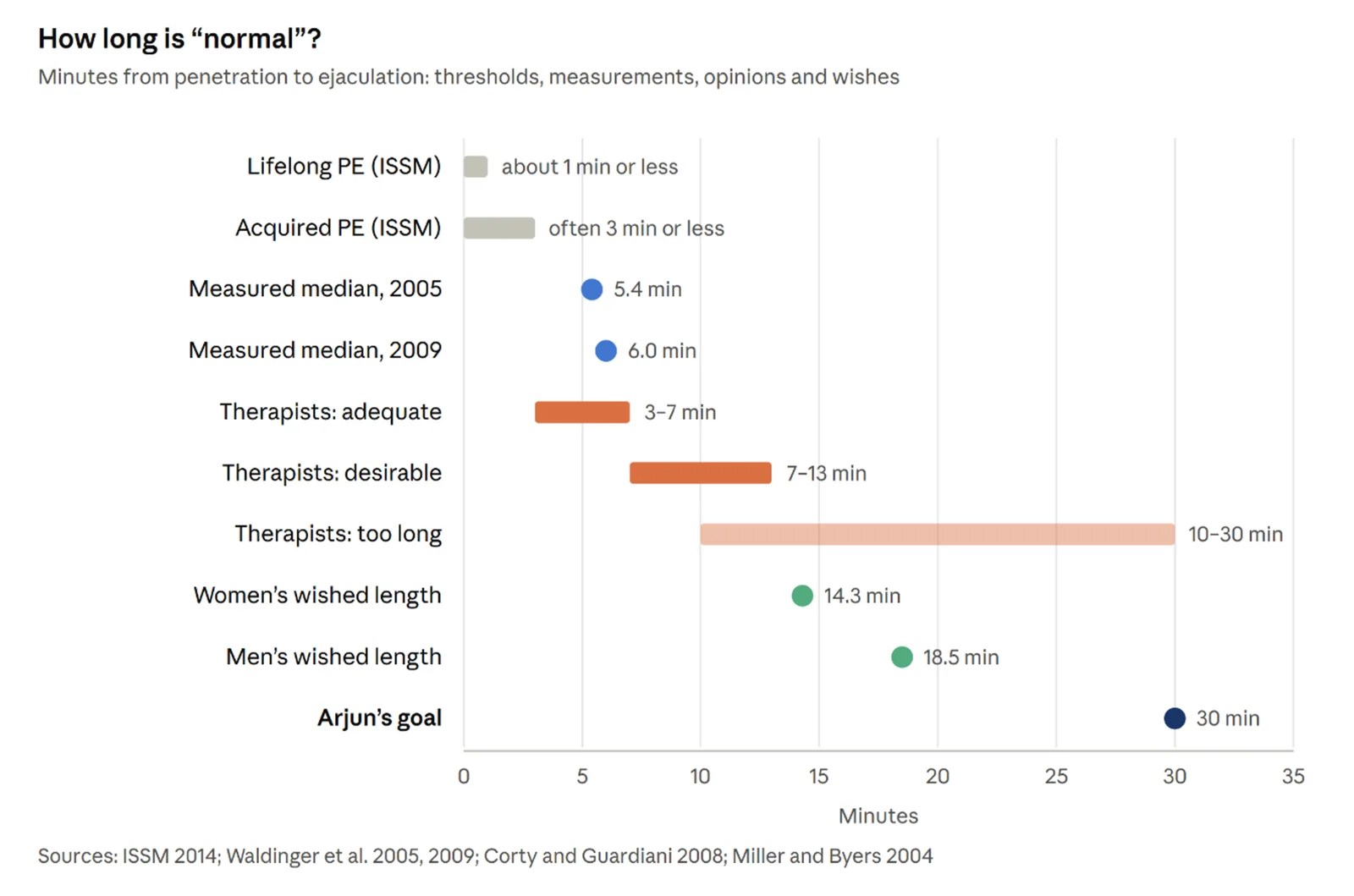
The distance between the blue dots, where real men sit, and the dark dot at the far right, where Arjun set his goal, is not a medical problem. It is a cultural one, and the rest of this essay is about where it comes from.
How the clock was built
It was not always obvious that a quick man was a failed one. When Alfred Kinsey published his famous survey of American men in 1948, he reported that about three-quarters of them ejaculated within two minutes of penetration in more than half of their encounters (Premature ejaculation). Kinsey did not treat this as a disorder. He pointed out that most mammals, including our closest primate relatives, ejaculate almost immediately, and regarded a quick human male as perfectly normal for his species (as discussed in a review of the definition debate).
The shift came in 1970, when the sex researchers William Masters and Virginia Johnson defined a premature ejaculator as a man who could not control ejaculation long enough to satisfy his partner in at least half of their encounters (definitions through history). It sounded generous to women. In practice it was a strange standard, because Masters and Johnson’s own laboratory work had shown that women generally need longer than men to reach orgasm, and most do not reach it through intercourse alone. Critics pointed out that the definition turned many normal men into patients, by making a man’s timing responsible for his partner’s orgasm (critique of the 1970 definition). Modern definitions, as we have seen, abandoned that approach. The cultural message did not.
Underneath the definitions lay a deeper assumption, which the New Zealand psychologists Kathryn McPhillips, Virginia Braun and Nicola Gavey called the “coital imperative”: the belief that penis-in-vagina intercourse is “real” sex, that everything else is merely “foreplay” leading up to it, and that it must end in orgasm to count as a success (McPhillips, Braun & Gavey, 2001; Farvid & Braun). Researchers have since linked this script, along with a related emphasis on men’s orgasm, to the gap in orgasms between women who have sex with men and women who have sex with women (Archives of Sexual Behavior, 2018).
Once sex is defined as intercourse, and intercourse as something a man does, the rest follows almost automatically. If sex is his performance, its quality is measured by how long he can sustain it. If her pleasure depends on his performance, her dissatisfaction is his failure. And if manhood must be continually proved, as the sixth essay described, then minutes become a currency men compare among themselves, in hostels and on WhatsApp groups, with each other rather than with their partners in mind. That, in plain language, is why the clock is patriarchal. It puts the man at the centre of sex, makes his endurance the gift, and turns the woman into the judge of a contest she never entered.
Modern pornography supplies the final piece. Its performers are selected for stamina, its scenes are edited, and its version of sex is built almost entirely around prolonged penetration. For many young Indian men, who receive no sex education at school and little honest conversation at home, it is the only picture of sex they have ever seen.
The Indian clock
India’s own erotic tradition took time seriously, but differently. The Kamasutra sorted both men and women into the “short-timed”, the “moderate-timed” and the “long-timed”, and treated the best union as a matter of matching partners rather than of a man hitting a target (Kamasutra, Book 2, Chapter 1). It recorded the popular objection that women love long-lasting men and resent quick ones, and answered it by insisting that men and women experience pleasure of the same kind. It even observed that a man’s time is short in the first encounter and longer in later ones, while a woman’s runs the other way. Elsewhere Vatsyayana remarked that love keeps no fixed order or schedule (same chapter). Whatever its other limits, this is a long way from a single heroic standard.
The modern Indian clock drew instead on the semen economy described in the second and fifth essays, in which semen is concentrated strength and its early loss a sign of weakness. In that framework, lasting long is proof of a well-stocked body, and finishing quickly is evidence of depletion. The vocabulary of the roadside sex clinic reflects it: “timing”, jaldi girna (falling early), shighrapatan, and a whole category of tonics, oils and capsules promising stambhan, the power to hold back. The first essay noted that some “herbal” products sold for sexual performance in India have been found to contain undeclared prescription drugs.
The pressure lands on bodies that are mostly normal. At a specialist psychosexual clinic at King George’s Medical University in Lucknow, researchers classified 101 men who came complaining of premature ejaculation. Forty-six had the acquired form, thirty-six the lifelong form, and nineteen, nearly one in five, had what Waldinger called premature-like ejaculatory dysfunction: normal timing, perceived as too fast. The authors noted that community surveys in China and Turkey have found the variable and subjective forms to be the most common types of complaint in the general population; clinics see a more severe group because those are the men who seek help (Tripathi et al., 2025). A small study in the Indian Journal of Urology, in which men recorded their own timing, found that men with genuine premature ejaculation averaged about 21 seconds, while men without it averaged nearly ten minutes (Jhanwar et al., 2021). True premature ejaculation, in other words, is unmistakable. Most of the worry sits far from it.
Indian circumstances add their own accelerants. Many couples first have sex on a wedding night that the whole family is aware of, as the third essay described. In joint households, sex often has to be quick and quiet, which trains the body to hurry. And in a country where school sex education has been resisted for two decades, many young men have never been told that most women need direct clitoral stimulation, that intercourse is not the only form of sex, or that five minutes is normal. The vacuum is filled by friends, pornography and advertisements, all of which have reasons to exaggerate.
How the clock makes things worse
The cruel irony of the clock is that watching it tends to make men faster, not slower. The third essay explained why. Ejaculation is driven partly by the body’s alarm system; anxiety and self-monitoring, what Masters and Johnson called “spectatoring”, push a man towards the very outcome he fears. A man who spends sex silently counting, checking or bracing himself is training his body to hurry.
The home remedies men use often deepen the problem. Distraction, thinking about work or reciting multiplication tables, does delay ejaculation for some, but it also removes the man from the encounter, which is precisely what Burri’s survey found women resented most. Numbing sprays dull sensation for both partners and do nothing about anxiety. Alcohol may slow ejaculation at the cost of erection. And when a man starts rushing because he fears losing his erection before he finishes, the problem being treated as premature ejaculation may really be erectile difficulty; men with the acquired form of premature ejaculation are more likely to have erectile problems and cardiovascular risk factors, which is why they need a medical check rather than a spray (Waldinger et al., 2009, discussion).
The psychological toll can be heavier for men whose timing is normal than for those with genuine disorder. A review of the pathophysiology of premature ejaculation noted that men with subjective complaints and normal timing appear to carry a greater burden of depression, low self-esteem, bother and sexual dissatisfaction than men with clinically defined premature ejaculation (McMahon). They are fighting not their bodies but an idea, and ideas are harder to medicate.
And the partner pays too. A wife whose husband is preoccupied with lasting longer gets less of what she actually values: touch, attention, playfulness, conversation. If she is never asked what she enjoys, he never learns that his stopwatch is measuring the wrong thing. Over time, sex can become something he dreads and she endures, which is how a cultural myth turns into the avoidance and distance that the ISSM definition lists as consequences of a disorder.
Counterpoints and limits
None of this means premature ejaculation is imaginary. Lifelong premature ejaculation, with ejaculation within about a minute from the very first experiences, is a genuine condition with a strong biological component, linked to serotonin signalling and inheritance, as the second essay described. Men who have it deserve treatment, not a lecture about culture, and effective treatment exists. In a large 24-week trial across 22 countries, men with premature ejaculation who took dapoxetine, a short-acting medicine taken before sex, saw their average time rise from 0.9 minutes to 3.2 or 3.5 minutes depending on dose, against 1.9 minutes with placebo, with improvements in control and satisfaction (Buvat et al., 2009). Behavioural methods such as the stop-start and squeeze techniques, and counselling that involves the partner, also help many couples.
Nor do all women find duration unimportant. In Burri’s survey, roughly four in ten women did list the short time as a source of distress, and women who considered duration important were more likely to report having ended relationships over it (Burri et al., as reported). Preferences vary from woman to woman and couple to couple, and the right answer for any one couple comes from asking, not from averages.
The evidence base has gaps. Almost all population studies of timing come from Europe, North America and Turkey; India has no comparable stopwatch survey, and very little research on what Indian women themselves want. The argument that the clock is a product of patriarchy is an interpretation that fits the evidence well, but other forces are at work too, including commerce, pornography and the general tendency of modern life to measure and optimise everything.
Finally, saying that a worry is cultural does not make it less real. A man who believes he is failing suffers whether or not his stopwatch agrees. Reassurance helps many men, but for some the anxiety has deeper roots, in the mind, the marriage or the family, which later essays take up.
What it means
For men, the first step is to put the stopwatch away, literally and figuratively. If you last more than two or three minutes, you are almost certainly within the normal range, and the median man lasts five or six. If you consistently ejaculate within about a minute, have done so since your first experiences, and it troubles you, see a qualified doctor rather than a roadside clinic or an online seller; this is treatable. If your timing has recently dropped, or you find yourself rushing because you fear losing your erection, get a medical check-up, because erectile and cardiovascular problems may be involved. And whatever your timing, ask your partner what she enjoys. The answer may relieve you more than any capsule.
For couples, the most useful change is to stop treating intercourse as the whole of sex. Touch, oral sex, manual stimulation and simply taking time are not “foreplay” to be rushed through but sex in their own right, and for most women they matter more for pleasure than minutes of penetration. When the pressure to last is removed, many men find that they last longer anyway. Sensate focus, the therapy described in the third essay, is built on exactly this insight.
For clinicians, the question “how long do you last?” is only the beginning. Ask how long he thinks he should last, and where that idea came from; ask about control, distress and the partner’s view; distinguish lifelong, acquired, variable and subjective forms, because their treatments differ; and treat erectile difficulty first when both are present. For the many men with normal timing, accurate information and reassurance are real treatment, not a brush-off.
For parents, schools and media, the long-term answer is honest sex education that describes how sex actually works for both partners, including how ordinary five minutes is. A generation that grows up knowing this will buy fewer sprays and suffer less.
Key takeaways
Premature ejaculation, properly defined, means ejaculation within about a minute from the first experiences, or a clear drop to about three minutes or less, together with lack of control and real distress; by that definition only a small minority of men have it. In stopwatch studies the median man lasts between five and six minutes, sex therapists regard three to thirteen minutes as normal, and many men who complain of being too fast are in fact entirely normal. Most women reach orgasm through clitoral stimulation rather than intercourse alone, and women whose partners worry about timing are most frustrated not by brevity but by their partner’s preoccupation with his performance. The clock itself grew out of a view of sex centred on intercourse and on the man’s endurance, sharpened in India by the semen economy, a market for “timing” products, hurried sex in crowded homes and the absence of sex education. Watching the clock tends to make things worse. Genuine premature ejaculation deserves and responds to treatment; the far more common problem of false expectations responds to information, conversation and a broader idea of what sex is.
Sources and further reading
Definitions and normal timing
- ISSM unified definition of premature ejaculation (2014)
- ISSM quick reference guide to premature ejaculation
- Classification and definition of premature ejaculation, review
- Premature ejaculation gets a unified definition, NBC News
- Waldinger et al., Multinational stopwatch survey of 500 couples (2005)
- Waldinger et al., Five-nation blinded-timer survey (2009)
- Waldinger et al. (2009), full discussion
- Intravaginal ejaculation latency time, overview
- Perceptions of ejaculatory latency in Ghana, discussing the four subtypes
- McMahon, The pathophysiology of acquired premature ejaculation
Women’s experience
- Burri et al., Female partners’ perception of premature ejaculation, Nature Reviews Urology summary (2014)
- Burri et al. (2014), detailed findings
- Women also suffer from premature ejaculation, University of Zurich
- Herbenick et al., Women’s orgasm and genital touching, summarised by the ISSM (2018)
- Herbenick et al. (2018), PubMed
- Corty and Guardiani, Sex therapists on how long intercourse should last, Penn State (2008)
- Corty and Guardiani (2008), journal article discussing Miller and Byers
History and the coital imperative
- Premature ejaculation, overview including the Kinsey figures
- Definitions of premature ejaculation from Masters and Johnson onwards
- Critique of the 1970 Masters and Johnson definition
- McPhillips, Braun and Gavey, Defining (hetero)sex: the coital imperative (2001)
- Farvid and Braun, A critical encyclopedia of heterosex
- Are women’s orgasms hindered by phallocentric imperatives? (2018)
India
- The Kama Sutra of Vatsyayana, Burton translation, Project Gutenberg
- Tripathi et al., Clinical subtypes of premature ejaculation, King George’s Medical University (2025)
- Jhanwar et al., Ejaculation timing in Indian men, pilot study (2021)
Treatment
Disclaimer: This content is for general information only and does not replace professional medical advice. Asmidev is not responsible for any diagnosis made based on this content, nor does it endorse or take responsibility for external websites or products mentioned. Always consult a qualified healthcare professional for health-related concerns. This article was created through a human–AI collaboration. The ideas and direction come from the author’s research, with AI used only to assist in organizing information and refining expression, while cross-checking against established scientific literature.


