

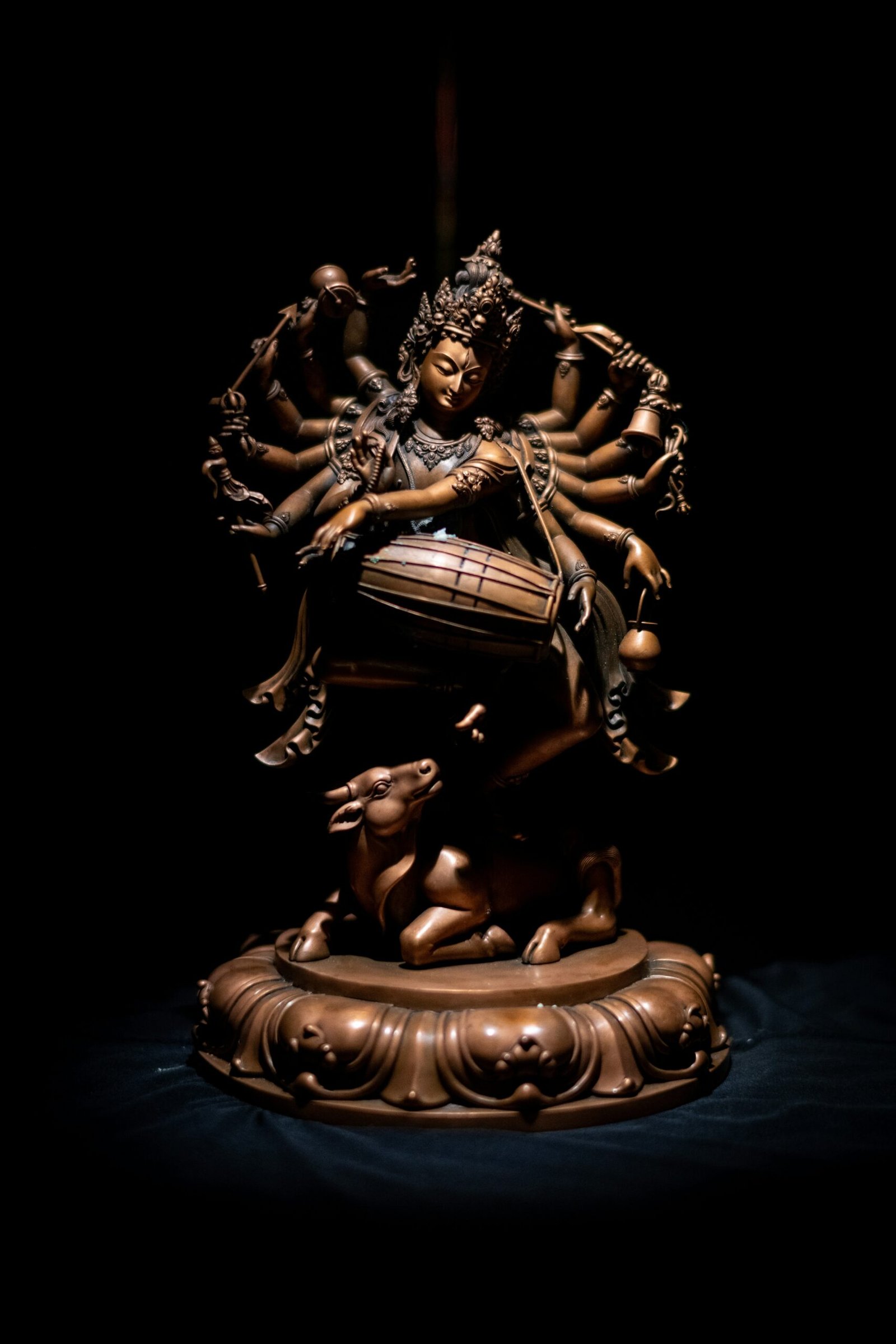
The Silent Bedroom · Article 5 of 18 (This article was originally published on Substack)
The question at Khajuraho
Suresh is forty-six, a software architect in New Jersey, and this summer he has brought his fifteen-year-old son Aryan to India to “see where we come from”. Their guide at Khajuraho is cheerful and unembarrassed. He points to the temple walls: dancers, musicians, warriors, and, here and there, couples locked in frank and acrobatic embrace. “This was our culture,” he says. “Nothing hidden.”
Aryan grins and nudges his father. Suresh feels his face grow hot. He is remembering his own father’s slap when, at fourteen, he was caught with a magazine. He is remembering his mother’s warnings, delivered without ever naming the subject, that wasting oneself would make a boy weak. He is remembering a wedding night in Pune, twenty years ago, when he was so anxious that nothing worked, and the long silence afterwards.
That evening in the hotel, Aryan asks the question Suresh has been dreading. “If it’s on the temples, why does nobody at home ever talk about it? Why did Dadi get upset when the kissing scene came on TV?”
Suresh has no answer. He has never had one. He grew up in a tradition that carved desire into its holiest buildings, and a family that treated it as unspeakable. This essay is an attempt to answer Aryan’s question.
Suresh and Aryan are a composite.
A civilisation in argument with itself
The temples Suresh and Aryan visited were built by the Chandela kings roughly between 950 and 1050 CE. Of some 85 temples, about 25 survive, and only around a tenth of their carvings are erotic; the rest show gods, warriors, musicians and the business of daily life (Khajuraho overview; Cultural India). That proportion is itself a clue. Desire was not the centre of the sacred world, but it was not exiled from it either. It had a place.
Aryan’s question, how a culture that carved such scenes into its temples could raise sons in such silence, has no single answer, because Indian religious tradition never spoke about sex with a single voice. Over three thousand years it produced at least five distinct voices, and they argued with one another:
- The celebrant, who treated desire as a cosmic force and a legitimate goal of life, and wrote manuals of pleasure.
- The lawgiver, who regulated desire through caste, marriage and the guarding of women.
- The physician, who taught that semen was the body’s most precious essence and its loss dangerous.
- The renouncer, who saw desire as the chain binding the soul and celibacy as the path to power and liberation.
- The devotee, who redirected erotic longing towards God and produced some of the most sensual poetry in any language.
The timeline below places the main texts and movements this essay discusses in rough order.

Indian men inherited all five. But families, schools and priests did not transmit them equally. The lawgiver, the physician and the renouncer spoke most loudly in the home. The celebrant was left on temple walls and in Sanskrit texts few people read. The devotee’s eroticism was permitted, but only when aimed at the divine.
This essay reads these traditions not as claims about faith, which is not its business, but as a culture’s long conversation about desire, and as the source of ideas that still shape how Indian men feel in bed. Myths, in particular, will be treated the way some psychologists treat dreams: as stories that reveal a community’s wishes and fears. That approach, associated with the psychoanalyst Sudhir Kakar, is one lens among several. The next essay will examine it more closely.
Desire as a legitimate goal
Start with the framework that most Hindu thinkers shared. Classical tradition named four aims of human life, the purusharthas: dharma (righteous duty), artha (prosperity), kama (pleasure, love and desire) and moksha (liberation). Kama was not a sin to be tolerated. It was one of the legitimate goals of a complete life (Puruṣārtha overview).
But legitimacy came with a ranking. When the aims conflicted, dharma came first; even the Kamasutra itself ranked dharma above artha and artha above kama (same overview). Desire was honoured, but on a leash held by duty.
The aims were mapped onto four stages of life, the ashramas: the celibate student (brahmacharya), the householder (grihastha), the forest-dweller who gradually withdraws (vanaprastha) and the renunciant (sannyasa). Kama belonged to the householder, the stage that begins with marriage (same overview; Philosophy Institute).
Notice what this framework does to a young man’s sexuality. Before marriage, the ideal is celibacy; the word for the student stage, brahmacharya, came to mean sexual abstinence itself. Desire is not abolished. It is postponed and then licensed in a single, sudden transition: the wedding. A boy is expected to be sexually absent until one night, and then sexually competent from the next morning. The framework that dignified desire also created the conditions for the wedding-night examination described in the third essay of this series.
The Vedic voice: desire at the beginning of the world
The oldest layer of the tradition is strikingly unembarrassed. The Rig Veda’s famous Hymn of Creation, which wonders how anything came to exist at all, places desire at the very origin of the cosmos. In Ralph Griffith’s 1896 translation: “Thereafter rose Desire in the beginning, Desire, the primal seed and germ of Spirit” (Rig Veda 10.129). Before gods, before the world, there was kama.
The same collection preserves a remarkable conversation between a woman and her husband. In hymn 1.179, attributed in part to Lopamudra, the wife of the sage Agastya, she complains that long years of austerity are wasting their bodies, and asks her husband to set his rituals aside and come to her. He resists, then yields; the hymn ends with their union (Lopamudra; Dharmawiki summary). The mythologist Devdutt Pattanaik reads it as one of the earliest statements of a tension that runs through the whole tradition, between the celibate hermit and the householder, and notes that commentators associated Lopamudra with Rati, the goddess of pleasure (Pattanaik). Here, three thousand years ago, is a woman who initiates, and a sacred text that records her desire without disapproval.
The Upanishads, the philosophical texts that followed, went further in one direction and darker in another. The Brihadaranyaka Upanishad treats intercourse as a form of sacrifice, the woman’s body as the altar, and the act, rightly understood, as equal in merit to a great Vedic ritual (Hume translation). It even includes a formula a husband may recite when he does not want his wife to conceive, a reminder that sex was understood as more than reproduction (Brihadaranyaka 6.4.10, Hume translation).
But the very same passage contains a verse that modern readers cannot pass over. If the woman will not yield, it says, the man should first offer gifts; if she still refuses, he should strike her with a stick or his hand and overcome her (Max Müller translation, 6.4.7; Hume). Classical commentators, including Shankara, read the verse literally; some modern defenders argue that the Sanskrit verb can mean “approach” or “persuade” rather than “strike” (one modern reinterpretation). Either way, the juxtaposition is instructive. The text that made sex sacred also imagined a husband entitled to it. Celebration and coercion were present at the same moment, in the same chapter.
The lawgiver and the physician
If the Vedic voice placed desire at the origin of the world, the legal texts set out to fence it in. The most influential, the Manava Dharmashastra or Laws of Manu, probably took shape around the second or third century CE (Manusmriti overview). Its ninth chapter, on husbands and wives, contains some of the most quoted lines in modern Indian debates about women. In Georg Bühler’s 1886 translation: a woman is protected by her father in childhood, her husband in youth and her sons in old age, and “a woman is never fit for independence” (Manu 9.3).
What matters for this series is the reason Manu gives. Women, the text says, “do not care for beauty, nor is their attention fixed on age”; thinking it enough that he is a man, “they give themselves to the handsome and to the ugly” (9.14). Through their passion for men and their changeable temper, they become disloyal however carefully they are guarded, and so every man should exert himself to guard them (9.15-16) (same chapter). The logic is worth noticing. The guarding of women is justified by a belief in women’s boundless desire. That belief, and the anxiety it carries, will return later in this essay.
The lawgivers also treated male sexual fluid as a matter of ritual purity. Manu prescribes that a man who has “spent his strength” is purified by bathing (Manu 5.63); intercourse, too, requires a bath (Manu 5.144). Desire was permitted, but its physical traces were pollution to be washed away.
The body’s most precious essence
The physicians added a theory that would prove even more durable. Classical Ayurveda describes the body as built in seven successive tissues, each refined from the one before: food becomes plasma, then blood, muscle, fat, bone, marrow and finally shukra, the reproductive essence, described as the most refined product of the whole chain (review of shukra dhatu; dhatu overview). A specialised branch, vajikarana, was devoted to restoring sexual vigour.
In fairness to the physicians, Ayurveda did not itself make celibacy an ideal or sex a sin; some modern Ayurvedic teachers stress that it attaches little moral weight to sexual expression (Ayurveda College). But the image of semen as a distillate of the whole body, built drop by drop from food and blood, travelled far beyond the clinic. Folk belief turned it into an economy: semen as savings, ejaculation as expenditure, nightfall and masturbation as leakage. That economy is the direct ancestor of the Dhat syndrome described in the third essay, and of the “timing” capsules sold on railway walls.
The celebrant: an art of pleasure
Around the same time that Manu’s law code was taking shape, a scholar named Vatsyayana compiled the Kamasutra, composed in Sanskrit in roughly the third century CE (Mirage News). In the West it became a byword for exotic positions. In fact it is a manual for the cultivated urban life of its time, covering grooming, the arts, courtship, conversation and the conduct of love affairs, of which the chapters on sex are only one part.
Three features matter for this series.
It treats pleasure as its own goal. The Kamasutra sets aside procreation as the purpose of sex, a striking departure from the lawgivers (description of Doniger’s Redeeming the Kamasutra).
It takes women’s pleasure seriously. The Sanskritist Wendy Doniger argues that Vatsyayana was, by the standards of his age, an advocate of women’s pleasure, of their education, and of their freedom to choose partners and express desire. Unlike legal texts that barred women from learning, the Kamasutra assumes women will read it (Mirage News summary of Doniger; Goodreads summary).
It is not innocent either. Doniger also points to passages that link passion with violence and that explain away a woman’s protests as a way of exciting her partner (same description). The celebrant’s voice, too, carried the assumptions of its time.
The same spirit appears in stone. Khajuraho, Konark and many lesser-known temples carry erotic sculpture on their outer walls. One common interpretation is that the carvings represent the worldly life a devotee leaves behind before entering the sanctum, where no such images appear (Cultural India). Even in that reading, desire is not denied. It is placed in the world, honoured as part of life, and kept outside the innermost shrine.
What happened to this voice? It was never silenced. It was simply never invited home. Few Indian parents have read the Kamasutra; fewer would hand it to a son. Colonial prudery and nationalist respectability, the subject of the seventh essay, later pushed it further to the margins. The irony that troubled Aryan at Khajuraho is real: the tradition contains one of the world’s oldest and most sophisticated books about mutual pleasure, and most Indian men learn about sex from friends, rumour and pornography instead.
Gods who break the rules
The Puranas, composed over many centuries in the first and second millennia CE, gave Indians their most beloved stories. Many of those stories are about desire, and they handle it very differently depending on who desires.
Krishna and the gopis. In the Bhagavata Purana’s account of the rasa lila, the cowherd women of Vrindavan hear Krishna’s flute at night, leave their homes and husbands, and dance with him in the forest (Raslila). The text anticipates the obvious objection. King Parikshit asks how the very protector of dharma could consort with other men’s wives. The sage Shuka replies with a phrase that became famous: tejīyasāṁ na doṣāya, roughly “for the powerful, there is no fault”, like fire, which consumes everything and remains pure (Bhagavata 10.33.29). The next verse warns that ordinary people who imitate such conduct court ruin (Bhagavata 10.33.30, as discussed by Schweig).
Devotional traditions read the episode as an allegory of the soul’s longing for God, and the Bhagavata itself promises that hearing it will free the listener from lust (Raslila). That reading deserves respect. But stories also teach outside their intended meanings. A boy who grows up singing of Krishna among the gopis absorbs an image of male desire that is irresistible, multiple and exempt from the rules, alongside a lesson that he himself must never act on it.
Shiva in the pine forest. In a cluster of Puranic myths, Shiva enters the Daruvana forest as a naked, ithyphallic ascetic. The sages’ wives are drawn to him; the furious sages curse his phallus to fall, and it becomes an infinite pillar of fire before which they must bow (Bhikshatana). Some versions present the visit as a lesson for proud sages; others describe Shiva as genuinely aroused (pine forest myth cycle). Either way, the god’s desire is cosmic and finally worshipped.
The women who are punished. Set beside these stories the fate of mortal women who desire. In the Mahabharata, Renuka, wife of the sage Jamadagni, glimpses a king bathing with his wives and feels a moment of longing. For that moment, her husband orders his sons to kill her; four refuse and are cursed, and the fifth, Parashurama, beheads her, before asking that she be restored to life (Renuka; Vedapath summary). Ahalya, seduced by the god Indra in her husband’s form, is cursed by that husband; Indra, too, is punished, but it is Ahalya who must wait in disgrace until Rama’s arrival redeems her (Ahalya).
The pattern is not universal, and devotees will rightly point to deeper meanings. But as stories absorbed in childhood, they draw a line. On one side stands male divine desire: playful, abundant, exempt. On the other stands female human desire: dangerous, punishable, permitted only when it can be redeemed. This essay will call the first side the divine exemption. Its echo in ordinary life is the indulgence extended to powerful men, the godman, the landlord, the boss, whose appetites are excused as somehow above judgement.
Desire turned toward the divine
Two later currents gave desire an extraordinary place in Indian religion, and both are easily forgotten when Indians describe their tradition as sexually conservative.
The goddess and Tantra. Tantric traditions, which spread from roughly the middle of the first millennium CE, treated the body, and sometimes ritual transgression, as a path to power and liberation; UNESCO notes that the Chandela kings who built Khajuraho were strongly influenced by Tantric thought (Khajuraho overview). At the Kamakhya temple in Guwahati, one of the most sacred Shakti sites, there is no idol at all. The goddess is worshipped as a yoni-shaped cleft in the rock, and each June the temple closes for three days during the Ambubachi Mela, which celebrates the goddess’s menstruation, before reopening to vast crowds (Kamakhya Temple; Ambubachi Mela). In a country where menstruating women are still kept out of kitchens and temples, the holiest shrine of the goddess honours the very bleeding that ordinary households treat as pollution.
The poets of longing. The Bhakti movement, which swept India from the seventh century onwards, made love the path to God, and some of its greatest poets were women who wrote of that love in openly erotic terms.
- Andal, an eighth- or ninth-century Tamil saint and the only woman among the twelve Alvars, refused marriage to any mortal and wrote the Nachiyar Tirumozhi, verses of such sensual longing for Vishnu that some are still rarely recited in public (Nachiyar Tirumoli). When the lyricist Vairamuthu praised her in 2018 as perhaps the first Tamil feminist, and cited a paper calling her a devadasi, he faced protests and threats (Scroll).
- Akka Mahadevi, a twelfth-century Kannada poet-saint, declared Shiva her only husband, left the king who claimed her and, by tradition, walked away clothed only in her hair (Akka Mahadevi).
- Jayadeva’s Gita Govinda, a twelfth-century Sanskrit poem of Radha and Krishna’s love, frankly erotic in places, became part of the ritual recitation at the Jagannath temple in Puri (Somasundaram & Raghavan).
- Muddupalani, an eighteenth-century courtesan-poet at the Thanjavur court, wrote Radhika Santawanam, a long poem centred on a woman’s own desire. When the singer and scholar Bangalore Nagarathnamma republished the full text in 1910, she asked why men’s erotic poetry was honoured and a woman’s called obscene. The colonial government banned it in 1911; the ban was lifted only after Independence, when Madras Chief Minister T. Prakasam said he was restoring pearls to the necklace of Telugu literature (Feminism in India; DT Next).
This is a rich inheritance, and it complicates any claim that Indian tradition simply silenced women’s desire. But notice the condition attached. Women’s passion is celebrated most freely when its object is God. Andal may burn for Vishnu; she may not burn for a neighbour. Muddupalani, who wrote of a woman’s pleasure in human terms, was the one who was banned. The tradition found a sacred home for female desire, safely aimed at a beloved no husband could compete with.
The insatiable woman
In the Mahabharata’s Book of Instructions, the dying Bhishma is asked a question by Yudhishthira: in the act of love, who takes the greater pleasure, the man or the woman? Bhishma answers with a story. King Bhangashvana, cursed by Indra, is transformed into a woman. As a woman he bears children, lives happily, and when finally offered the chance to become a man again, refuses. A woman’s pleasure in union, he explains, is far greater than a man’s (Mahabharata, Anushasana Parva). Greek myth tells an almost identical story of the seer Tiresias, which suggests that the idea speaks to something widespread in men’s imaginations rather than anything peculiarly Indian.
The story is often cited today as evidence that ancient India acknowledged female pleasure. It did. But place it beside Manu’s claim, quoted earlier, that women give themselves to any man, handsome or ugly, and must therefore be guarded day and night. The two texts share a premise: women’s desire is vast. They draw opposite lessons from it. One marvels; the other locks the door.
Why would men, who wrote nearly all these texts, imagine women’s appetite as boundless? Here an idea from psychoanalysis is genuinely illuminating, offered as an interpretation rather than a proven fact. The analyst Karen Horney argued in the 1930s that men carry a deep, mostly unspoken “dread of woman”: a fear of being measured against female desire and found inadequate. A man whose erection subsides after orgasm, who cannot match an imagined woman’s endless capacity, may respond either with awe or with control. Indian tradition, on this reading, did both. The next essay explores this line of thought in depth.
There is a cruel irony here, and it can be checked against data. In a study of more than 52,000 American adults, 95% of heterosexual men said they usually or always reached orgasm during sex, compared with 65% of heterosexual women; the gap shrank among lesbian women (Frederick et al., 2018). The insatiable woman of male fantasy is, in real heterosexual bedrooms, more often the unsatisfied one. The fear projected onto her says more about men’s anxieties than about women’s bodies, and it turns the wife into a judge before she has said a word.
The counter-models hiding in plain sight
If the tradition supplied the divine exemption, it also supplied its own alternatives. They are worth naming, because each could help Indian men, and Indian couples, imagine a different sexual life. Each has also been blunted.
Lopamudra, the wife who asks. The Rig Veda’s record of a woman voicing her desire and her husband answering it is about as clear a model of mutual, spoken desire as any ancient text offers. It survives mainly in scholarship. Few Indian boys have heard of her.
Draupadi, the woman with five husbands. The heroine of the Mahabharata is married to all five Pandava brothers, and is honoured in the daily recitation of the panchakanya, the five exemplary women whose names are said to remove sin (Panchakanya). Yet in the dice hall, when she is dragged before the court, Karna insults her as a woman of loose character precisely because she has more than one husband (Draupadi). She is revered and shamed for the same fact, which neatly captures the tradition’s double vision.
Radha, the beloved outside marriage. In much of the devotional tradition Radha’s love for Krishna is parakiya, a love that defies marriage and social convention, and it is held up as the highest form of devotion. Indian families sing her songs at festivals and hang her pictures in their homes. Many of the same families resist a son’s or daughter’s choice of partner. Radha’s defiance is honoured as theology and forbidden as practice.
Andal and Akka Mahadevi, women who chose. Both refused the husbands others chose for them and declared their own desire. Both are revered as saints, on condition that their desire was for God.
The goddess who bleeds. Kamakhya’s celebration of menstruation, and the Chengannur temple in Kerala, which closes for the goddess’s periods (Chengannur Mahadeva Temple), sit uneasily beside the exclusion of menstruating women from many shrines. The question has reached the Supreme Court. In May 2026, a nine-judge bench reserved judgment in the long-running reference that grew out of the Sabarimala temple case, a reference that also covers Muslim women’s entry into mosques and Parsi women’s access to fire temples; as of early October 2026, no verdict had been delivered (Niyam explainer; National Revealed).
The pattern across these figures is consistent. The tradition preserved powerful images of women who desire, choose and refuse. But it placed them at a safe distance, in the remote Vedic past, in the epic’s exceptional circumstances, in devotion to God, or in the body of a goddess, rather than in the ordinary household where a young husband and wife actually meet.
Sacred quarantine: what reaches the bedroom
Put the voices together and a single structure emerges. This essay calls it sacred quarantine: desire is honoured, even worshipped, in the register of gods, myths and temples, and policed in the register of the household. The erotic was not erased from Indian tradition. It was relocated to places where ordinary men and women could admire it without having to live it.
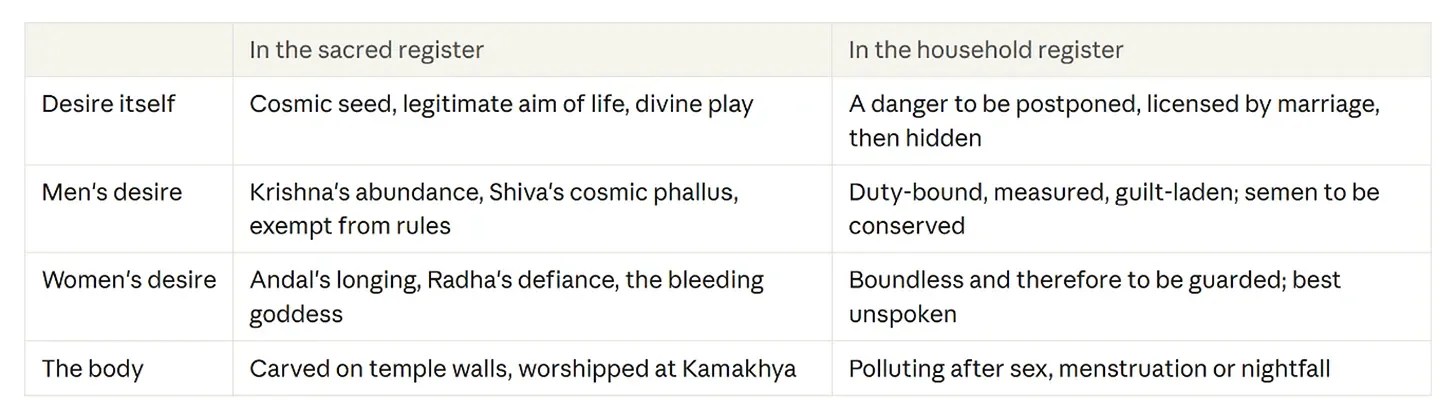
For Indian men, the inheritance shows up in the bedroom in at least five ways.
- A sudden licence. Desire is absent by rule until marriage, then expected on demand. The tradition gives no apprenticeship between celibate student and competent husband, which is exactly the gap in which wedding-night anxiety grows.
- A leaking bank account. The physician’s image of semen as the body’s most precious essence, turned into folk belief, makes every ejaculation feel like a loss. Men who carry it hurry to finish, or fear that they have already spent too much, a direct line to the Dhat syndrome and premature ejaculation described earlier in this series.
- Two impossible models. Indian men are offered two great male figures. Rama, the faithful husband, is admired for restraint and duty. Krishna, the irresistible lover, is admired for abundance and play. Neither describes an ordinary man in an ordinary marriage, and a man who measures himself against Krishna’s legendary potency, or Rama’s flawless control, is set up to feel inadequate either way. Pornography, with its tireless performers, is in some ways a modern rasa lila that sharpens the same comparison.
- A suspicious eye on her desire. A man raised on the idea that women’s appetite is limitless and must be guarded may be unsettled, rather than pleased, when his wife shows desire. Her initiative can feel like a threat, or a test he might fail. Some men respond by keeping sex brief, functional and on their terms; others by avoiding it.
- A wife taught silence. Women raised in the same system learn that desire is holy when aimed at God and suspect when aimed at a husband. Many cannot say what they want, and many husbands never learn to ask. The result is the silent bedroom this series is named for: two people performing duties no one ever explained, each afraid of the other’s judgement.
None of this is fate. Every one of these patterns has a counter-voice inside the tradition itself: kama as a legitimate aim, Lopamudra’s spoken desire, Vatsyayana’s insistence on a woman’s pleasure. The task, for men and for couples, is less to abandon their inheritance than to claim the parts of it they were never given.
Beyond the Hindu texts
This essay has drawn mainly on Hindu textual traditions, because they supplied the dominant vocabulary of desire in much of India. But India’s men are Muslim, Christian, Sikh, Jain, Buddhist, Parsi and nonreligious as well, and their traditions speak differently.
Classical Islamic thought, for instance, does not treat celibacy as a virtue, and its jurists describe sexual fulfilment within marriage as a right of both spouses. The eleventh-century theologian al-Ghazali wrote that a husband is obliged to meet his wife’s needs (SeekersGuidance; Islamic marital jurisprudence). Sikh teaching rejected renunciation in favour of the householder’s life. Jain and Buddhist traditions, by contrast, made monastic celibacy the highest path.
Yet the patterns this series describes cut across faiths. A clinic study from West Bengal found Dhat syndrome widespread among Muslim as well as Hindu men (West Bengal Dhat study). Arranged marriage, family surveillance of the couple, silence about sex and the anxious wedding night are shared by Indian families of very different scriptures. That is a useful corrective. It suggests that what shapes Indian men’s sexual lives is less any single holy text than a shared social order of caste, kinship, patriarchy and honour, which each religious community has interpreted in its own idiom. Later essays examine that social order directly.
Two later filters also intervened between the ancient texts and modern bedrooms. Colonial rule brought Victorian ideas of obscenity, the criminalisation of homosexuality, and bans like the one on Muddupalani’s poem. Nationalist leaders, eager to prove Indian civilisation respectable, often accepted those standards and promoted celibacy as a source of moral and national strength. The seventh essay of this series tells that story.
What this essay cannot claim
Texts are not bedrooms. Very few Indian men have read Manu, the Upanishads or the Kamasutra. Their influence travels indirectly, through rituals, proverbs, family warnings, television serials and the stories grandmothers tell. The links drawn here between ancient words and modern anxieties are interpretive, not measured.
Quotation is a weapon in both directions. Lines from Manu are quoted by critics to condemn the whole tradition and dismissed by defenders as later interpolations or misreadings. Many Hindus reject Manu’s authority altogether; reformers from within the tradition have long contested it. This essay quotes difficult passages because they were influential, not because they define Hinduism.
Reading myths psychologically does not cancel their spiritual meaning. To a devotee, Krishna’s dance with the gopis is the soul’s longing for God, and Andal’s verses are the purest devotion. Both readings can be true at once: a story can be sacred and still teach lessons its tellers never intended.
Scholarship itself is contested. Western and Indian scholars of these texts disagree with one another, and some devotees regard academic readings of sacred stories as disrespectful. Dates for many texts are uncertain by centuries.
India is not one tradition. Matrilineal communities, Adivasi societies, regional devotional movements and the differing kinship patterns of north and south produced very different sexual cultures. The eighth essay of this series returns to that diversity.
What this means
For men. You inherited more than shame. Your tradition also counts desire among the legitimate aims of life, records a wife asking her husband for love, and produced one of the world’s first books insisting on a woman’s pleasure. Semen is not a finite treasure; the belief that it drains strength has no medical basis. Neither Krishna’s legend nor Rama’s perfection is a standard for an ordinary marriage.
For couples. The quarantine is broken by speech. Lopamudra’s hymn is, at heart, a conversation: one partner says what she wants and the other answers. Couples who can name desire, preference and fear in plain words remove much of the exam from the bedroom.
For parents. Silence does not produce chaste sons; it produces sons who learn about sex from rumour, quacks and pornography. A father who can tell his son that desire is normal, that nightfall and masturbation are harmless, and that a wife’s pleasure matters, will have done more than any temple carving.
For educators and religious teachers. Many Indians assume that frank sex education is a Western import that contradicts their heritage. The opposite case can be made from within the tradition, from the Vedic hymn of creation to Vatsyayana. Religious teachers who present kama as one of the four aims of life, rather than as a shameful necessity, can help young people approach marriage with knowledge rather than dread.
For Aryan’s question. The honest answer Suresh could give his son is this: the temples and the silence are both our inheritance. Our ancestors argued about desire for three thousand years. We are allowed to keep the best of what they said.
Key takeaways
- Indian tradition never spoke with one voice about desire. Celebrant, lawgiver, physician, renouncer and devotee all contributed, and they disagreed.
- Kama was a legitimate aim of life, but ranked below duty, postponed until marriage and then licensed suddenly, setting up the wedding-night exam.
- The Vedic layer honoured desire, including a wife’s spoken longing in Lopamudra’s hymn, yet the same Upanishadic chapter that made sex sacred also imagined a husband’s coercion.
- Manu justified guarding women by their supposedly boundless desire; Ayurveda’s image of semen as the body’s finest essence became the folk “semen economy” behind Dhat syndrome.
- The Kamasutra treated pleasure, including women’s, as a goal in itself, but it was rarely invited into Indian homes.
- Male gods’ desire is exempt and celebrated; mortal women’s desire is punished or permitted only toward God. This essay calls the result “sacred quarantine”.
- Counter-models exist (Lopamudra, Draupadi, Radha, Andal, the bleeding goddess) but were kept at a safe distance from ordinary marriages.
- Across faiths, the patterns owe as much to a shared social order of caste, kinship and patriarchy as to any single scripture, a theme the following essays take up.
Sources and further reading
Temples and the four aims
- Khajuraho, its erotic reliefs and the Chandelas
- Khajuraho Group of Monuments, Cultural India
- Puruṣārtha overview
- The ethical path in Hinduism: stages of life and supreme goals
Vedic and Upanishadic texts
- Rig Veda 10.129, Griffith translation
- Lopamudra
- Agastya and Lopamudra dialogue, Dharmawiki
- Devdutt Pattanaik, Lopamudra’s consent
- Brihadaranyaka Upanishad VI.4, Hume translation
- Brihadaranyaka Upanishad VI.4, Max Müller translation
Law and medicine
- Manusmriti overview
- The Laws of Manu, chapter IX (Bühler)
- The Laws of Manu, chapter V (Bühler)
- Review on the formation of shukra dhatu
- The seven dhatus explained
- Shukra dhatu from the Ayurvedic perspective
The Kamasutra
- Kamasutra challenges taboo on women’s sexual pleasure
- Doniger, Redeeming the Kamasutra (summary)
- Doniger, Redeeming the Kamasutra (description)
Puranic stories
- Raslila
- Bhagavata Purana 10.33.29 and its citations
- Schweig, Dance of Divine Love, foreword
- Bhikshatana and the pine forest
- Siva and the pine forest myth cycle
- Renuka
- Parashurama and Renuka, Vedapath
- Ahalya
- The story of Bhangashvana, Mahabharata
Tantra, goddess and Bhakti
- Kamakhya Temple
- Ambubachi Mela
- Chengannur Mahadeva Temple
- Nachiyar Tirumoli
- The Vairamuthu controversy, Scroll
- Akka Mahadevi
- The romance of Radha: a journey with Jayadeva
- Muddupalani, Feminism in India
- Restoring a few pearls to the necklace of Telugu literature, DT Next
Counter-models and the present
- Panchakanya
- Draupadi
- The Sabarimala nine-judge reference, Niyam
- Justice Nagarathna begins writing Sabarimala reference verdict
- Frederick et al., orgasm gap among 52,588 adults (2018)
Other faiths
- Islam and the wife’s sexual rights, SeekersGuidance
- Islamic marital jurisprudence
- Dhat syndrome in men in West Bengal
Disclaimer: This content is for general information only and does not replace professional medical advice. Asmidev is not responsible for any diagnosis made based on this content, nor does it endorse or take responsibility for external websites or products mentioned. Always consult a qualified healthcare professional for health-related concerns. This article was created through a human–AI collaboration. The ideas and direction come from the author’s research, with AI used only to assist in organizing information and refining expression, while cross-checking against established scientific literature.


