


The Silent Bedroom · Article 6 of 18
The door he could not close
Vivek is thirty-one, a chartered accountant in Lucknow, married four years to a woman he chose himself, or nearly: his mother approved the match, which in his family amounts to the same thing. The early years were good. Then their daughter was born, and something in Vivek went quiet.
He still loves his wife. He admires her: the way she manages the baby, his ageing parents and a job. He would say, if anyone asked, that she is a wonderful mother. But when they are alone, he finds he does not want her. When he tries, his erection fades. Late at night, alone with his phone, he has no such trouble. He is ashamed of this, and confused by it.
His mother lives with them, as she has since his father died. She sleeps across the corridor. When Vivek closes the bedroom door at night, he feels, absurdly, that he is doing something wrong, as if he were slipping away from her. On the evenings his wife and mother quarrel, he sides with neither and feels he has betrayed both.
Vivek has seen two doctors. One gave him tablets, which help a little. The other told him it was stress. Neither asked about his mother, his father, or what it means to him that his wife is now the mother of his child. This essay is about those questions.
Vivek is a composite, drawn from patterns described in clinical literature.
A note to the sceptical reader
Many thoughtful readers flinch at the word “psychoanalysis”. They have reason to. In its heyday it made sweeping, untestable claims, treated speculation as fact, and too often blamed mothers for problems that later turned out to have other causes. Some of its most famous ideas, such as Freud’s fixed stages of psychosexual development, have not held up.
But it is worth separating the parts that failed from the parts that survived. In a landmark review in Psychological Bulletin, the psychologist Drew Westen argued that critics usually attack an outdated version of the theory that most clinicians themselves have abandoned. What has survived scientific testing, he concluded, is a core set of ideas: that much of mental life is unconscious; that people hold conflicting feelings at once and often reach compromises between them; that childhood relationships shape how we form later ones; and that we carry inner images of ourselves and others that guide behaviour (Westen, 1998; full paper). Psychodynamic therapy, the modern descendant of psychoanalysis, has also been tested: a widely cited review in American Psychologist found its effects comparable to other evidence-based therapies and often lasting after treatment ends (Shedler, 2010), although critics have challenged some of that review’s calculations (discussion).
This essay leans on the work of Sudhir Kakar, India’s best-known psychoanalyst, who spent decades listening to Indian patients and reading Indian myths, alongside a few classic Western thinkers. To keep the argument honest, each of the next sections is built in three layers:
- What can be observed: family patterns, stories and experiences most Indian readers will recognise.
- What has been measured: research that has tested related ideas by other means.
- The interpretation: the psychoanalytic reading, in plain language, offered as one way to make sense of the first two, not as proven fact.
Readers are invited to judge the interpretation by a simple test: does it explain something the other layers leave unexplained?
The mother: a closeness that comforts and overwhelms
What can be observed. Picture the traditional Indian household that produced most of today’s fathers and grandfathers. A young bride arrives among strangers, often with little say in her marriage and little intimacy with her husband. Her standing in the family rises sharply when she bears a son. That son becomes, very often, the emotional centre of her life: carried, fed by hand, sleeping beside her for years, defended against every complaint. As he grows, she expects him to stay close, to live with her, to take her side. The rivalry between mother-in-law and daughter-in-law is so familiar that it has sustained an entire genre of Indian television. And fathers, then and now, are less present in the daily work of care: in 2024, 41% of Indian women aged 15 to 59 took part in caregiving for household members on a given day, against 21.4% of men (Time Use Survey, via ORF).
What has been measured. No study has directly measured the bond described below. But a large body of research on attachment, an idea that grew out of psychoanalysis and was then tested in laboratories, shows that early bonds shape how adults handle closeness and separation. Two small clinical studies point in the direction this essay takes. Men with lifelong premature ejaculation showed significantly higher attachment anxiety, a chronic fear of losing those one depends on, than men without ejaculatory problems (clinical study of 91 men). Men with lifelong delayed ejaculation showed more insecure attachment of both anxious and avoidant kinds (attachment and delayed ejaculation). These findings do not prove any particular theory about Indian mothers. They do show that the shape of early closeness can follow a man into bed.
The interpretation. Sudhir Kakar described, in his work with Indian male patients, a pattern he called maternal enthrallment: a mother-son bond so intense that it shapes the man’s later relationships with women (Kakar, 2016; article text). In plain language, it is a closeness that comforts and overwhelms at the same time. Three threads run through it:
- The pull between leaving and staying. Growing up means moving away from mother towards the world of men and, eventually, towards a wife. For a son who is his mother’s main source of love and status, every step away can feel like abandonment, of her and by her.
- The mother as lifeline. A boy who receives almost all his nurture from one person learns that she is his lifeline. Her approval becomes the measure of his worth, and her disappointment a kind of danger.
- The unspoken charge. A bond this intense, between a lonely woman and the son who fills her life, can carry feelings that neither can name. The son senses that he is needed in ways a child cannot meet, and feels responsible for her happiness.
Kakar is careful, and so should we be, to locate the cause not in mothers but in the system around them. A woman married into a household where her own need for intimacy goes unmet will understandably pour it into her son. The pattern is a product of arranged distance between husbands and wives, not of any mother’s character.
In the bedroom. For a man shaped this way, marriage asks for a quiet act of leaving: turning his deepest loyalty from mother to wife. Many men never quite complete it. The bedroom door becomes charged with guilt, as it was for Vivek. The wife may feel like a rival rather than a partner, and desire for her can carry a faint sense of betrayal. Kakar observed in his clinical work that his patients’ sexual problems often included impaired potency alongside an anxious fear of being unable to satisfy the woman; on this reading, a man who has never emotionally left his first home finds it hard to be fully present in his second.
The father: distant, feared, and the son who yields
What can be observed. In many Indian homes the father is less a companion than an authority. Sons address him with formality, rarely argue, and learn early that “because I said so” ends a discussion. Affection, where it exists, is often expressed through provision rather than words or touch. Decisions about a son’s education, career, marriage and even the timing of children may be taken, or at least ratified, by the father and other elders.
The stories reflect this. In the most famous Greek myth of fathers and sons, Oedipus kills his father. In the most famous Indian ones, sons give way. Bhishma renounces marriage and sex for life so that his father Shantanu can marry the woman he desires. Puru gives his own youth to his father Yayati, who has been cursed with old age, so that Yayati can go on enjoying pleasures that should have been his son’s (Yayati; Puru). Shiva, returning home, beheads the boy Ganesha who is guarding his mother’s door.
What has been measured. A meta-analysis of 43 studies from around the world found that children’s and adults’ sense of being accepted or rejected by their parents is linked to their psychological adjustment, regardless of culture (Khaleque & Rohner, 2002). Later reviews found that a father’s acceptance often matters as much as a mother’s, and sometimes more (Khaleque & Rohner, pancultural review). A distant or rejecting father is not a neutral absence.
The interpretation. The poet and scholar A. K. Ramanujan, in a celebrated essay called “The Indian Oedipus”, and the Sanskritist Robert Goldman, studying fathers and sons in the epics, both noticed this reversal: in Indian tellings the threat usually comes from the father, and the son resolves the conflict not by rebelling but by yielding (Ramanujan and Goldman, as cited; discussion of the Indian Oedipus). In plain language: the son’s fear is less the guilt of defeating his father than the dread of his father’s displeasure, and he copes by surrendering what the father might resent, including, in Bhishma’s and Puru’s cases, his own sexuality.
Kakar also described more tender figures in Indian lore, fathers who are utterly absorbed in their children (Kakar’s father archetypes). The picture is not of cruel fathers, but of a hierarchy in which a son’s adult desire is something granted rather than owned.
In the bedroom. A man raised to yield may carry an unspoken sense that his potency is borrowed, that it exists by permission of those above him. His marriage was arranged by elders; his duty is to produce an heir for the lineage; the family will be watching for “good news”. Sex becomes another act of obedience. Some men in this position find it hard to want actively, to initiate, to claim pleasure as their own. Others carry an anger they were never allowed to express towards their fathers, which turns inward as anxiety or outward as irritability towards their wives.
When respect switches off desire
What can be observed. Indian culture has an abundance of words for the respected woman: devi (goddess), grihalakshmi (the household’s goddess of prosperity), ma. A good wife is praised for her sacrifice, her purity, her care of children and in-laws. Many Indian men speak of their wives this way, sincerely. And many, like Vivek, find that desire fades once a wife becomes a mother, while it survives perfectly well in fantasy, pornography or thoughts of other women. The pattern is common enough that it rarely surprises clinicians, and rarely gets discussed at home.
What has been measured. This is one psychoanalytic idea that experimental psychology has tested directly. Researchers in Israel defined the Madonna-whore dichotomy as the tendency to see women’s nurturance and sexuality as mutually exclusive: a woman is either good and caring or sexual and dangerous. Men who held this view more strongly endorsed patriarchal beliefs and reported lower satisfaction in their relationships, an effect explained by lower sexual satisfaction (Bareket et al., 2018, Sex Roles; summary). The association with patriarchal beliefs was replicated in Israel, the United States and Germany (Kahalon et al., 2019), and men higher on the dichotomy rated their partners as less entitled to sexual pleasure (Sex Roles, 2023). The lead researcher summarised the cost plainly: such men may struggle to feel attracted to the women they love, or to love the women they desire (EurekAlert).
The interpretation. Freud described this in 1912, in an essay on what he called “psychical impotence”. Love, he argued, has two currents: an older affectionate current, formed in childhood around mother and family, and a sensual current that arrives with puberty. In healthy development the two join on the same partner. When they fail to join, the result is a divided love life, which he summed up in a famous line: “where they love they do not desire and where they desire they cannot love” (Freud’s essay, discussed). Freud traced the split to a man’s early attachment to his mother: a woman who becomes too much like her reawakens the old prohibition, and desire retreats.
Kakar applied the idea to India with a striking reading of Manu. Behind the law-book’s lines on guarding women, he argued, lies male terror of female sexual appetite, defended against by idealising women as mothers (Kakar, Intimate Relations, publisher’s summary). Put plainly: when a man respects a woman in the way he respected his mother, desire can feel like a violation, so it switches off.
In the bedroom. This may be one of the commonest hidden scripts in Indian marriages after the first child. The wife becomes “the mother of my children”, honoured and unapproachable; sex becomes rare, dutiful or brief; desire migrates to screens or fantasies about women who feel “other”. She, meanwhile, concludes she is no longer attractive. Neither connects it to the husband’s mother, or to the culture that taught him a good woman cannot also be a desiring one.
The dread of being measured
What can be observed. Indian boys compare themselves early: size, stamina, “timing”. Wedding-night jokes revolve around whether the groom will “pass”. Many men prefer, openly or privately, a bride with no sexual past, and some are tormented by the thought that a wife might compare them with someone else. A wife who initiates sex, or says what she likes, can unsettle a husband rather than please him. The previous essay traced a long tradition of imagining women’s desire as boundless, from Manu’s warnings to the story of King Bhangashvana, who became a woman and found women’s pleasure far greater than men’s.
What has been measured. Social psychologists have tested the idea that manhood, unlike womanhood, is a fragile status that must be constantly proven. In five studies, Joseph Vandello, Jennifer Bosson and colleagues found that people widely see manhood as “hard won and easily lost”, defined more by social proof than by biology. When men received feedback suggesting they had performed in a gender-atypical way, their anxiety-related thoughts rose; the same kind of feedback had no such effect on women (Vandello et al., 2008; review). Separately, the third essay of this series described an experiment in which men felt more masculine when they imagined their partner reaching orgasm, especially men under strong pressure to be conventionally masculine. Her pleasure, in other words, can become his exam result.
The interpretation. In 1932 the psychoanalyst Karen Horney, who broke with Freud over his views of women, wrote an essay called “The Dread of Woman”. She argued that what men fear from women is not, as Freud had claimed, castration, but humiliation: a threat to masculine self-regard. A boy, she suggested, senses early that he is inadequate beside his mother, and the man carries a hidden anxiety about his size and potency, an anxiety with no real equivalent in women, who are not required to keep proving their womanhood (Horney’s concepts, summarised; Horney’s major concepts). She also proposed “womb envy”: men’s envy of women’s capacity to bear and nurse children, which she thought fed a tendency to belittle women (Womb envy).
One need not accept every detail to see what the idea explains. Put plainly: many men fear being measured by a woman and found wanting. The fantasy of the insatiable woman, the guarding of wives, the demand for a bride without a past and the obsession with “timing” can all be read as defences against that fear. Each keeps the woman from becoming a judge, or makes sure her verdict never has to be heard.
In the bedroom. A man in the grip of this dread approaches sex as a test he expects to fail. He may rush to finish before he can be judged, a pattern that feeds premature ejaculation. He may avoid sex altogether, or keep it brief and on his terms. He may find his wife’s enjoyment threatening rather than welcome, and her silence unbearable. And because he cannot speak of the fear, she cannot reassure him.
The ascetic escape
What can be observed. Indian culture offers men an honourable alternative to the anxieties described so far: renunciation. Its heroes include Hanuman, celibate and immensely strong, patron of wrestlers and gyms; Bhishma, whose vow of lifelong celibacy made him the most formidable warrior of the Mahabharata; and, in modern times, Gandhi, who made sexual abstinence a pillar of his moral and political life and whose psychosexual history Kakar examined at length (Intimate Relations). In these stories, the man who withholds his semen gains power; the man who spends it loses strength.
What has been measured. The idea has found a new audience online. Semen retention and “NoFap” communities, which urge men to abstain from pornography, masturbation or ejaculation, promise energy, confidence and even “superpowers”; the NoFap forum alone had more than 350,000 registered members (NoFap). A 2023 study of online “ejaculation training” courses found that they made unsubstantiated health claims, and that seven of ten instructors cited only their personal experience as qualification (International Journal of Impotence Research). Research on these forums finds a recurring theme: men describing abstinence as a way to take back a lost sense of power and control (discourse study). Whatever its benefits for compulsive pornography use, the belief that retained semen makes a man stronger has no medical basis.
The interpretation. Psychoanalysts use the term defence for the mind’s ways of protecting itself from feelings it cannot bear. Renunciation can work as an elegant defence. If desire is tangled with guilt towards a mother, fear of a father’s displeasure and dread of a woman’s judgement, then giving up desire altogether solves every problem at once, and earns admiration besides. Kakar observed that the celibate heroes of Indian lore carry unusual emotional intensity, as if they hold something more than a spiritual ideal. Put plainly: asceticism can turn a fear into a virtue. A man who cannot face sex can tell himself, and others, that he is conserving his strength.
None of this diminishes celibacy as a genuine spiritual path, chosen freely by monks, nuns and seekers in many traditions. The point is narrower: for some men, the language of conservation hides an anxiety that would be better faced than sanctified.
In the bedroom. The ascetic escape shows up as men who treat low desire as discipline, avoid ejaculation out of fear of weakness, or feel drained and guilty after sex rather than close and relaxed. It feeds the semen worries of Dhat syndrome and the hurried, guilty sex that sustains premature ejaculation. And it leaves wives confused: a husband who withdraws in the name of strength is, from her side of the bed, simply absent.
The inner cast
Put the five figures together and a picture emerges of everyone a man may be bringing into his marriage bed without knowing it.
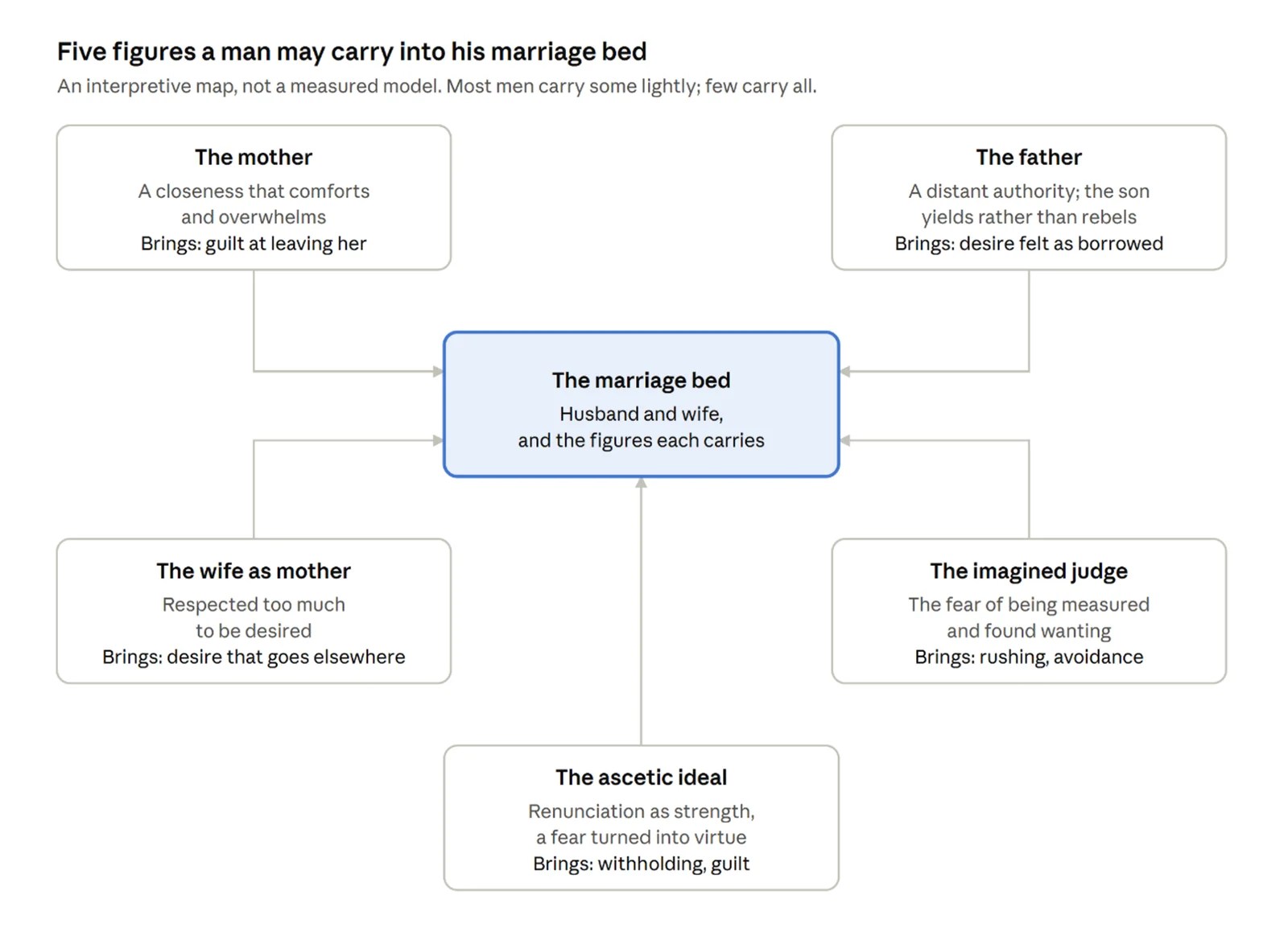
The map is deliberately modest. It is not a diagnosis, and it does not claim that every Indian man carries every figure. It is a way of asking, when something goes wrong in the bedroom, a question that tablets and timing tips never ask: who else is here?
How it shows up in the bedroom
No man carries all of these figures in equal measure, and many carry them lightly. But when they weigh heavily, they tend to produce a few recognisable patterns, each of which clinicians see regularly.
Desire that works everywhere except with her. Erections are firm with fantasy, pornography or a stranger, and fail with the wife. Physically, this tells a doctor that the plumbing works. Psychologically, it often points to the split between the respected woman and the desired one, sometimes sharpened by her becoming a mother.
Failure at the threshold. Erection holds until the moment of penetration, then fades. The man can approach but not enter, as if some permission were missing. Readers of the third essay will recognise performance anxiety here; this essay adds the question of whose permission he is still waiting for.
Rushing. Sex is hurried to its end before judgement can be passed or strength can be lost. The dread of being measured and the semen economy both push in the same direction, towards premature ejaculation.
Withdrawal after children. Sex becomes rare and dutiful once the wife becomes a mother, and the couple drifts into a companionable, sexless partnership that neither discusses.
The triangle. Quarrels between mother and wife leave the husband frozen, unwilling to choose. The bedroom becomes either a refuge or a battleground, and in either case not a place of ease.
Her side of the bed. For the wife, each of these patterns looks like the same thing: rejection. Most Indian women have been given no language for a husband’s inner conflicts, and many conclude that the problem is their body, their desirability or their failure as wives. They carry their own inner cast too, the subject of later essays on couples and on women’s changing expectations.
One practical point follows. When erectile difficulties are situational, present with a partner but absent alone or on waking, they are a strong sign that the mind is playing a large part. That is good news: it means the body is capable, and that the work lies in the relationships, outer and inner, that surround it.
What this reading cannot claim
The evidence is uneven. Of the five figures above, only one, the split between respect and desire, has been tested directly in experiments. The mother-son bond, the yielding son and the dread of being measured rest on clinical observation, myth and plausible links to research on attachment and masculinity. They are interpretations, and should be held as such.
The sample was narrow. Kakar himself acknowledged that clinical psychoanalysis in India draws on a small group of patients from three or four large cities (Kakar, 2016). Critics have noted that his portrait of “Indian” sexuality is largely a portrait of Hindu, upper-caste, heterosexual men, and that real Indian families have larger casts than the Freudian trio of mother, father and son (review of Intimate Relations). Dalit, Adivasi, Muslim, Christian, rural and queer men may live quite different stories.
Mothers are not the problem. Psychoanalysis has a history of blaming mothers, and that history should not be repeated here. The intense mother-son bond described in this essay is a rational response by women to a system that denied them other sources of intimacy, status and security. Change the system and the bond changes too.
Families are changing. Nuclear households, working mothers, fathers who change nappies, love marriages and premarital acquaintance are all reshaping the inner cast of younger Indian men. Patterns drawn from the families of the 1970s and 1980s may fit today’s thirty-year-olds less well, and today’s ten-year-olds less still.
Western theory, Indian lives. Some scholars argue that applying Freud to India imports foreign categories; others, including Kakar, Ramanujan and Roland, argued that Indian material actually reshapes psychoanalytic theory, as with the “Indian Oedipus”. The reader is entitled to treat the whole framework as a set of useful questions rather than a set of answers.
What this means
For men. The value of this kind of reading is not diagnosis but recognition. When guilt rises as you close the bedroom door, ask whose disappointment you are afraid of. When desire vanishes for a wife you admire, ask whether you have quietly turned her into someone you are not allowed to want. When you feel examined in bed, ask who the examiner is. Naming the inner cast loosens its grip. For men whose patterns run deep, psychodynamic therapy, which works with exactly these themes, has evidence of effects comparable to other psychotherapies, often lasting beyond treatment (Shedler, 2010).
For couples. The most protective thing a couple can build is a space of their own: physical privacy, time together away from the family, and an understanding that the marriage, not the parental home, comes first. For many Indian husbands this means a second, emotional leaving home, done kindly, without abandoning parents, but without letting them sit in the marriage bed. After children arrive, couples do well to talk explicitly about desire, rather than letting “mother of my child” quietly replace “my partner”.
For parents. Sons who can leave home emotionally make better husbands. That is easier when mothers have intimate, satisfying marriages of their own and do not need a son to fill the gap, and when fathers are present, warm and willing to give their sons permission to become men in their own right. In practice, investing in the parents’ marriage may be one of the best gifts to a son’s future one.
For clinicians. Ask about the household: who lives there, who sleeps where, how the wife and mother-in-law get on, what changed after the first child. Note when erectile difficulty is situational. A prescription can restore an erection; it cannot settle a loyalty conflict or reunite affection and desire. Referral to a therapist who can work with these themes, alone or with the couple, is often the more lasting treatment.
Key takeaways
- Psychoanalysis earned scepticism, but some of its core ideas survived testing: unconscious processes, conflicting motives, and the influence of early relationships on later ones.
- The mother: an intense mother-son bond, born of a system that denied mothers other intimacy, can leave men feeling that turning towards a wife is a betrayal.
- The father: in Indian stories and many homes, sons resolve conflict by yielding, and adult desire can feel borrowed rather than owned.
- The wife: when respect and desire cannot coexist, a wife who becomes “the mother of my child” stops being desirable; this split has been measured, and it lowers men’s sexual and relationship satisfaction.
- The dread of being measured: manhood experienced as fragile turns a woman’s pleasure into an exam, feeding rushing, avoidance and control.
- The ascetic escape: celibacy and “semen retention” can turn a fear into a virtue; the belief that retained semen brings strength has no medical basis.
- These are interpretations, not proofs, drawn largely from urban, Hindu, upper-caste clinical experience, and families are changing.
- Recognition helps: naming the inner cast, building a couple’s own space, and working with a therapist can loosen patterns that tablets alone cannot touch.
Sources and further reading
Psychoanalysis and the evidence
- Westen, The scientific legacy of Sigmund Freud (1998)
- Westen (1998), full paper
- Shedler, The efficacy of psychodynamic psychotherapy (2010)
- Shedler (2010), with critical discussion
Kakar and Indian psychoanalysis
- Kakar, The engulfing mother in Indian mythology (2016)
- Kakar (2016), article text
- Kakar, Intimate Relations: Exploring Indian Sexuality
- Intimate Relations, BiblioVault
- A critical review of Intimate Relations
- Kakar’s archetypes of the Indian father
- Ramanujan and Goldman on the Indian Oedipus, as cited in Ethos
- Examining the Oedipal complex in the Indian scenario
- Yayati and Puru
Attachment, parents and fathers
- Attachment and lifelong premature ejaculation
- Attachment and lifelong delayed ejaculation
- Khaleque & Rohner, parental acceptance-rejection meta-analysis (2002)
- Khaleque & Rohner, pancultural review
- Time Use Survey 2024, ORF
Respect, desire and dread
- Bareket et al., the Madonna-whore dichotomy (2018)
- Holding on to patriarchy-reinforcing beliefs comes at a price, ScienceDaily
- Bareket interview, EurekAlert
- Kahalon et al., the Madonna-whore dichotomy across three countries (2019)
- The Madonna-whore dichotomy and women’s sexual pleasure (2023)
- On Freud’s essay on debasement in the sphere of love
- Horney’s major concepts, including The Dread of Woman
- Womb envy
- Vandello et al., Precarious manhood (2008)
- Vandello & Bosson, Hard won and easily lost (review)
Renunciation, old and new
Disclaimer: This content is for general information only and does not replace professional medical advice. Asmidev is not responsible for any diagnosis made based on this content, nor does it endorse or take responsibility for external websites or products mentioned. Always consult a qualified healthcare professional for health-related concerns. This article was created through a human–AI collaboration. The ideas and direction come from the author’s research, with AI used only to assist in organizing information and refining expression, while cross-checking against established scientific literature.


