

The Silent Bedroom · Article 10 of 18
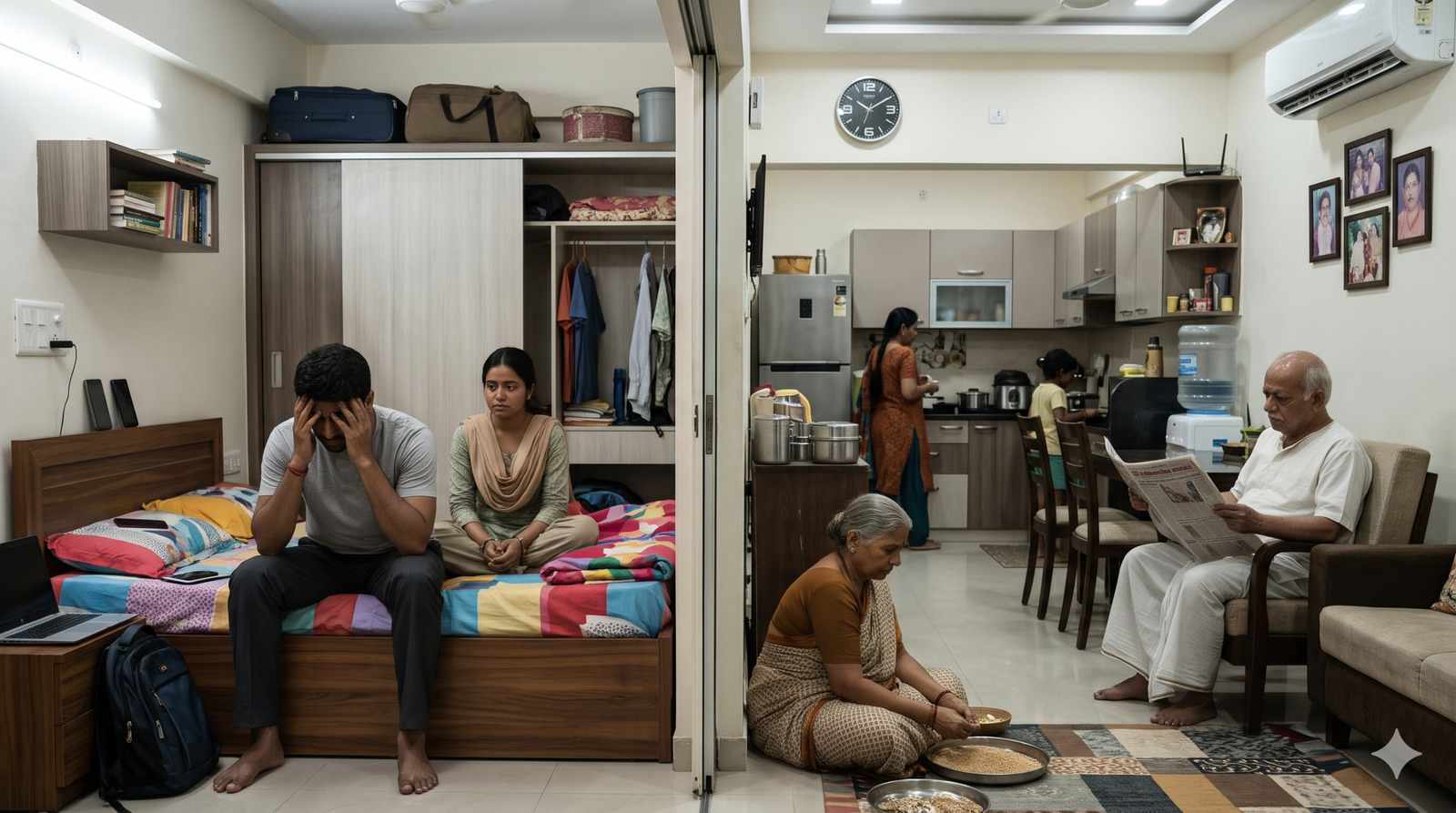
The thin wall
Sameer grew up in Surat in a two-room flat shared by seven people: his parents, his grandmother, two sisters, a brother and himself. The only door that locked was the bathroom’s, and there was always someone waiting outside it. That was where, at fourteen, he discovered masturbation, and where he learned to finish in the time it took to run a bucket of water. He felt guilty every time. A cousin had told him that each drop of semen cost forty drops of blood.
Now thirty, Sameer is married and lives in a larger flat with his parents, his brother’s family and his wife. He and his wife have their own room, separated from his parents’ by a wall he is sure carries every sound. They have sex late at night, with the lights off and the fan on, quickly and almost silently. He ejaculates within a minute or two. His wife has never told him whether she minds. They have never really talked about it, because there has never really been a place to talk.
When Sameer finally saw a doctor, he was asked when the problem began. He did not know how to answer. As far as he could remember, sex had always been like this: hidden, hurried and over almost before it started.
Sameer is a composite.
The core question
The previous essay argued that much of Indian men’s anxiety about premature ejaculation comes from an imaginary clock. This one turns to the real circumstances in which many Indian men live their sexual lives, and asks what those circumstances do to them. Three features of the traditional household stand out: hierarchy, which decides whose needs come first and who may speak; hurry, the pressure to get sex over with quickly; and hiding, the long habit of keeping everything sexual secret, from adolescence to old age.
A caution is needed at the outset. The first essay in this series noted that the proportion of Indian men with premature ejaculation is roughly in line with the rest of the world. If crowded homes and secrecy were a major cause of the condition, we would expect India’s rate to be far higher, and it is not. The argument here is narrower and more interesting: that hierarchy, hurry and hiding shape how sex is learned, how it is practised, how premature ejaculation is experienced and whether anything is done about it. They may push some men from normal into the variable or acquired forms; above all, they turn an ordinary sexual difficulty into a lonely and shameful one.
The evidence here is mixed in strength. Data on housing, household structure and attitudes are established. The idea that rapid ejaculation can be learned through hurried early experiences is an old clinical theory with weak and conflicting support. The links drawn between household structure and the bedroom are interpretations, supported by a handful of Indian studies of couples.
Hurry: can speed be learned?
Sameer’s story echoes one of the oldest ideas in sex therapy. In the 1970s, Masters and Johnson and the psychiatrist Helen Singer Kaplan proposed that premature ejaculation was a conditioned reflex: when masturbation or intercourse is repeatedly hurried, out of fear of discovery, anxiety or guilt, the body learns to respond quickly, and the habit sticks (Cochrane review, background). Masters and Johnson’s examples were American, the back seat of a car, a hurried visit to a sex worker, but an Indian reader can easily supply local ones: the shared bathroom, the curtain instead of a door, the bedroom next to the parents’ room.
The idea is intuitive, and it shaped decades of treatment. The trouble is that it has never been well tested. A Cochrane review of psychological treatments described the proposed causes of premature ejaculation, from early conditioning to anxiety, as speculative (Cochrane). A later review noted that it is not known whether hurried early experiences are actually more common in men with premature ejaculation than in other men (Premature ejaculation: definition and pathophysiology). And the lifelong form behaves more like a stable trait than a learned habit: in one study, 77% of men with lifelong premature ejaculation said their timing had not changed at all since their first sexual experiences (lifespan study).
Research on masturbation, the most obvious place where hurried habits might form, is contradictory. In a large sample of urban Chinese men, more frequent masturbation was associated with more ejaculatory problems (Chinese urban men). In a Brazilian study of young men who have sex with men, the reverse held: more frequent masturbation went with a lower chance of premature ejaculation, while men who habitually tried to hold back ejaculation were more likely to report it (Brazilian study). A Chinese study of unusual masturbation techniques found no link with premature ejaculation at all (Archives of Sexual Behavior).
The honest conclusion is that hurried habits probably do not create lifelong premature ejaculation, which has strong biological roots. But they may shape the variable and acquired forms, and they plainly shape the experience. Reviewers have also suggested that frequent, relaxed sexual activity may help men become aware of the sensations before ejaculation and reduce anxiety (review). Infrequent, rushed, anxious sex, which is what crowded homes tend to produce, offers the opposite: little chance to learn, and plenty of fear. The Brazilian finding is a small reminder of the previous essay’s lesson: men who strain to hold back may make things worse.
Hiding: a sexuality learned in secret
For most Indian boys, sexuality begins as something to hide. There is rarely a parent willing to explain it, rarely a school that teaches it, and rarely a private space in which to explore it without fear. What fills the silence is a body of folklore that turns ordinary experiences into dangers.
Indian research has documented that folklore for half a century. In one early clinical cohort, about three-quarters of men with potency problems had masturbated before their problems began, and 43% felt guilty about it; 64% believed that losing semen harmed their health. A study of 1,000 consecutive patients at a psychosexual clinic found premature ejaculation to be the most common complaint, at 77.6%, followed by nocturnal emissions at 71.3% and guilt about masturbation at 33.4% (Sexuality research in India, review). The beliefs are not confined to the uneducated: one study found that more than half of Indian medical interns believed that losing semen could shrink the penis, cause physical weakness or reduce sexual capacity (as cited in a validation study). Masturbation itself is commonly described as a “bad habit” that thins the semen and weakens the body (Indian story on semen loss). Women are not spared: in a study of 530 college women in Gujarat, all of those who masturbated believed it caused weakness, disease, infertility or marital problems (Sharma & Sharma, 1998).
The vocabulary says everything. The traditional Hindi name for sexual problems is gupt rog, literally “secret disease”, and the clinics that treat it advertise on walls and in newspapers precisely because men will not ask anyone they know. The first essay in this series noted that most Indian men with sexual problems wait more than a year before seeking help.
The habit of hiding does not end at the wedding. In a study of women attending gynaecology clinics in India, 64% said they could not talk to their partners about sexual problems, even though most had them (Indian Journal of Community Medicine). Husbands and wives who have each learned that sex is unspeakable carry that lesson into the same bed.
What hiding costs is feedback. A boy who learns about sex in secret cannot check what he has heard against reality; he compares himself with exaggerated boasts and edited videos. A husband who cannot talk to his wife never learns what she actually feels. A man with a problem who cannot tell a friend or a doctor has only the roadside clinic. Each layer of secrecy removes a chance to discover that what he fears is common, or harmless, or treatable.
Crowded homes and thin walls
The physical setting of Indian sex is rarely discussed, but it matters. According to the 2011 Census, 37% of Indian households lived in a single room and another 32% in two rooms, with an average household size of 4.9 people. About 14% of households contained two married couples, and a further 4% contained three or more (State of Housing in India, 2013). For tens of millions of couples, the bedroom is not a private room at all, or it is a room with a curtain, a thin wall, a sleeping child or an in-law within earshot.
What that does to sex has been described most vividly in a six-year study of married women in a low-income community in Mumbai. Almost half of the 1,125 women had a negative view of sex with their husbands. Among the reasons they gave were a lack of foreplay, forced sex, the difficulty of finding privacy in crowded homes, poor communication, the lack of anywhere to wash afterwards and the wish to avoid pregnancy. The women who described satisfying sex lives pointed to the opposite: more equal relationships, husbands who accepted it when they did not want sex, a more affectionate, pyaar karna approach, the freedom to initiate, and more talk about both sexual and everyday matters (Mumbai study). A survey of women attending gynaecology clinics similarly found lack of privacy to be one of the commonest reasons for reduced sexual activity, cited by about a quarter (Indian Journal of Community Medicine).
The consequences for timing are easy to imagine. Sex in a crowded home happens late at night, in darkness and near-silence, with one ear on the door. There is little time for the slow build of arousal that most women need, and little room for touch, conversation or laughter. The man, aware of every creak, is in a state of low-level alarm, which, as the third essay explained, is exactly the state that speeds ejaculation and weakens erection. The aim becomes to finish before anyone notices. Over months and years, that aim can become a habit.
None of this is unique to India; working-class couples everywhere have made love in cramped quarters. What is distinctive is the combination of crowding with a culture that treats the couple’s sexual life as something to hide even from the people under the same roof, and that offers few other places to go.
Hierarchy: who controls time, space and voice
Crowding alone does not explain the Indian bedroom. Plenty of couples in small homes find ways to be close. What makes the difference, the Mumbai study suggests, is the quality of the relationship, and in particular whether it is equal enough for both partners to speak. That brings us to hierarchy.
In the traditional household, the couple’s time and space belong partly to others. Elders decide when the couple may retire for the night, whether their door may be closed, how soon a child is expected and what the young wife’s day will contain. That day is long. India’s 2024 Time Use Survey found that women spent 289 minutes a day on unpaid domestic work, against 88 minutes for men (The Wire). Men, for their part, work some of the longest paid hours in the world; analyses of labour-force data put the Indian average at about 47 hours a week, with roughly half of workers exceeding 49 (The Raisina Hills, citing ILO and PLFS data). By the time the household is asleep, both partners are exhausted. Sex is squeezed into the last minutes of the day.
Hierarchy also governs voice. The National Family Health Survey for 2019-21 found that 82% of married women said they could refuse sex with their husbands if they did not want it, a figure that is better than many expect. But 19% of men agreed that a husband has the right to get angry and reprimand a wife who refuses (ThePrint), and around 8% of women and 10% of men believed a wife cannot refuse at all (LatestLY, summarising NFHS-5). Being able to say no is not the same as being able to say “slower”, “not like that” or “I’d like to try this”. As the section on hiding showed, many women cannot even raise sexual problems with their husbands.
The interpretation. In a hierarchical marriage, sex tends to become something the senior partner does and the junior partner allows. The man sets the pace; the woman accommodates. There is no negotiation of tempo, no shared project of pleasure, and therefore nobody but the man to blame when it ends quickly. Hierarchy concentrates all the responsibility, and all the shame, in one person. The man at the top of the household finds himself, in bed, the only one being tested.
The loop
The three pressures do not act separately. Hierarchy decides who controls the couple’s time and who may speak; crowding and exhaustion create hurry; a lifetime of secrecy means nothing is said. Together they produce sex that is quick, silent and anxious. When it goes badly, the shame falls on the man alone, and shame is the most powerful reason of all to keep hiding. The loop closes.

The useful thing about a loop is that it can be broken at any point. Later sections of this essay, and later essays in the series, look at where.
How it shows up in the bedroom
The first pattern is the wordless marriage. Many couples shaped by hierarchy, hurry and hiding have never had a conversation about sex at all. They have sex regularly, sometimes for decades, without either partner knowing what the other enjoys, fears or wants. When one of them develops a difficulty, there is no language in which to raise it.
The second is the compressed encounter. When an entire sexual encounter, from first touch to sleep, has to fit into a few anxious minutes, the part that is cut is almost always the part that matters most for women: slow touch and arousal. Intercourse then begins before the woman is ready, which can make it uncomfortable or painful for her, and she comes to dread or merely tolerate it. Her reluctance raises his anxiety, his anxiety shortens the encounter further, and the women in the Mumbai study who described sex as something negative were often describing exactly this.
The third is the habit carried into marriage. Some men who learned to finish quickly in secret as boys find that the pattern persists with their wives, even when, alone and unhurried, they can last much longer. This variable, situational pattern is precisely the kind that responds to a change in circumstances and to the behavioural techniques described later in this essay, and precisely the kind that men tend to misread as a permanent defect.
The fourth is avoidance. A man who feels he fails every time may begin to avoid sex: working late, staying up until his wife is asleep, finding reasons. His wife, unable to ask, may conclude that she is no longer wanted. The silence deepens on both sides.
The fifth is the secret cure. A man who cannot speak to his wife, his friends or his family doctor turns to the products and clinics that profit from secrecy, with the results described in the first and previous essays.
There is also a hopeful pattern, which many clinicians hear about. Couples who manage to get away together, on a trip, a visit to the wife’s parents’ home, or simply a night in a hotel, often report that sex is slower, warmer and more satisfying away from the thin walls. It is a small natural experiment, and it points to how much of the problem lies in the setting rather than the man.
Counterpoints and limits
The most important counterpoint has already been made: India does not have unusually high rates of premature ejaculation. Whatever hierarchy, hurry and hiding do, they do not seem to multiply the condition itself. Lifelong premature ejaculation in particular is largely biological, and no change in living arrangements will cure it. The case made here is about how the condition is learned, lived with and hidden, not about what causes it in the first place.
The conditioning theory, which links hurried early experiences to rapid ejaculation, remains unproven. It is plausible, and many men recognise themselves in it, but the evidence is thin and the masturbation studies point in different directions. It should be held as a hypothesis, not a fact.
Joint families are not villains. They provide childcare, financial security, companionship and support in illness, and many couples within them have warm sexual lives. A study of Indian couples with sexual dysfunction found that their marital satisfaction depended less on verbal and sexual communication than Western models would predict, and the authors suggested that commitment to family stability and social support in arranged marriages might explain the difference (Manjula et al., 2021). Nuclear households, for their part, have their own pressures, including isolation and the absence of help.
The Indian evidence comes largely from clinics and from low-income communities such as the one studied in Mumbai. Middle-class couples with their own rooms may face fewer of these pressures, or different ones. And the picture is changing: between 2001 and 2011, the share of Indian households with nine or more members fell from 11.3% to 6.6% (Demographic Research). Smaller households will not end hierarchy or secrecy on their own, but they do change the physical conditions in which many couples meet.
What it means
For men, the first step is to set down the guilt you were handed as a boy. Masturbation does not drain your strength, thin your semen, shrink your penis or cause premature ejaculation; those beliefs are folklore, and carrying them into marriage only adds anxiety. The second step is to slow down deliberately rather than straining to hold back. The stop-start technique, in which stimulation is paused just before the point of no return and then resumed, is designed to teach awareness of the sensations that precede ejaculation; it can be practised alone first and then with a partner. The evidence for such behavioural methods is limited in quality (Cochrane), but they are safe, cheap and often help men whose difficulty is situational. If ejaculation has always come within about a minute, see a qualified doctor as well.
For couples, the most practical change may be to protect time and space. That can mean negotiating a closed door and an undisturbed hour with the family, choosing a time of day when neither partner is exhausted, or getting away together now and then. It also means talking, ideally outside the bedroom first, about what each enjoys and what each finds difficult. Letting the woman set the pace of arousal, and treating touch as an end in itself rather than a preliminary, takes much of the hurry out of sex. The sensate focus exercises described in the third essay are built for exactly this.
For families, the kindest thing elders can do for a young couple is to give them privacy without comment: a door that stays shut, an evening without demands, no questions about “good news”. Sharing domestic work more fairly gives a young wife something just as valuable: enough energy left at night to want anything at all.
For clinicians, the setting belongs in the history. Ask who else lives in the home, whether the couple has a private room, when and how sex usually happens, and what the man believes about masturbation and semen. Distinguish the variable, situational pattern from the lifelong one. Reassurance, accurate information and simple behavioural techniques, with the wife involved where possible, can make a real difference, and they cost far less than the products sold in secret.
Key takeaways
India’s rate of premature ejaculation is not unusually high, so crowded homes and secrecy do not appear to cause the condition itself; lifelong premature ejaculation is largely biological. What hierarchy, hurry and hiding shape is how sex is learned, practised and suffered. The old theory that hurried early experiences condition men to ejaculate quickly is plausible but unproven, and studies of masturbation point in different directions; men who strain to hold back may do worse. Indian research shows that guilt about masturbation and fear of semen loss remain widespread, even among medical interns, and that many women cannot discuss sexual problems with their husbands. Over a third of Indian households live in a single room, and in a Mumbai study crowding, lack of foreplay and poor communication were among the reasons women viewed sex negatively, while equality, affection and the freedom to initiate made sex better. Long working days, women’s heavy domestic load and household hierarchy leave couples exhausted and leave the man alone responsible for how sex goes. Together these pressures form a loop of quick, anxious sex and shame that deepens the silence, and the loop can be broken by protected time and space, honest conversation, the end of masturbation guilt, simple behavioural techniques and medical care where it is needed.
Sources and further reading
Conditioning and the causes of premature ejaculation
- Melnik et al., Psychosocial interventions for premature ejaculation, Cochrane review
- Premature ejaculation: an update on definition and pathophysiology
- A lifespan perspective on lifelong premature ejaculation (2025)
- Premature ejaculation among Chinese urban men: prevalence and correlates
- Premature ejaculation among young men who have sex with men in São Paulo
- Atypical masturbation and male sexual dysfunction, Archives of Sexual Behavior
Secrecy, guilt and semen-loss beliefs in India
- Sexuality research in India: an update, Indian Journal of Psychiatry
- Indian story on semen loss and related Dhat syndrome, Indian Journal of Psychiatry
- Masturbation beliefs scale, citing beliefs among Indian medical interns
- Sharma and Sharma, The guilt and pleasure of masturbation among college women in Gujarat (1998)
- Female sexual dysfunction: Indian perspective, Indian Journal of Community Medicine
Housing, privacy and the couple
- State of Housing in India: A Statistical Compendium (2013)
- Sexual intimacy and marital relationships in a low-income urban community in Mumbai
- One-person households in India, Demographic Research
- Manjula et al., Marital relationship and sexual interaction in couples with sexual dysfunction in India (2021)
Hierarchy, work and voice
- Time Use Survey 2024, The Wire
- Work-life balance in India, The Raisina Hills
- 82% of women able to refuse sex, NFHS-5, ThePrint
- NFHS-5 attitudes to refusing sex, LatestLY
Disclaimer: This content is for general information only and does not replace professional medical advice. Asmidev is not responsible for any diagnosis made based on this content, nor does it endorse or take responsibility for external websites or products mentioned. Always consult a qualified healthcare professional for health-related concerns. This article was created through a human–AI collaboration. The ideas and direction come from the author’s research, with AI used only to assist in organizing information and refining expression, while cross-checking against established scientific literature.


