

The Silent Bedroom · Article 7 of 18
A marriage made under the law
Call him Raghav. In December 2013, when he was twenty-four, the Supreme Court of India restored a colonial-era law that made sex between men a crime. Raghav had known since school that he was attracted to men. He had told no one. When his parents began arranging his marriage the following year, he did not resist. The law, his family and his own fear all pointed in the same direction.
His wedding night was a quiet disaster. He could not sustain an erection, and his bride, who had been told almost nothing about sex, assumed the fault was hers. Over the following months he learned to manage with fantasy and, eventually, with tablets. They had a son. He loves his son.
In September 2018 the Supreme Court changed its mind and struck down the law. Raghav read the news on his phone in the office bathroom and wept. Nothing in his life changed. He was still married, still a father, still unable to tell anyone the truth, including the woman who shares his bed and still believes that she is the reason it is so often cold.
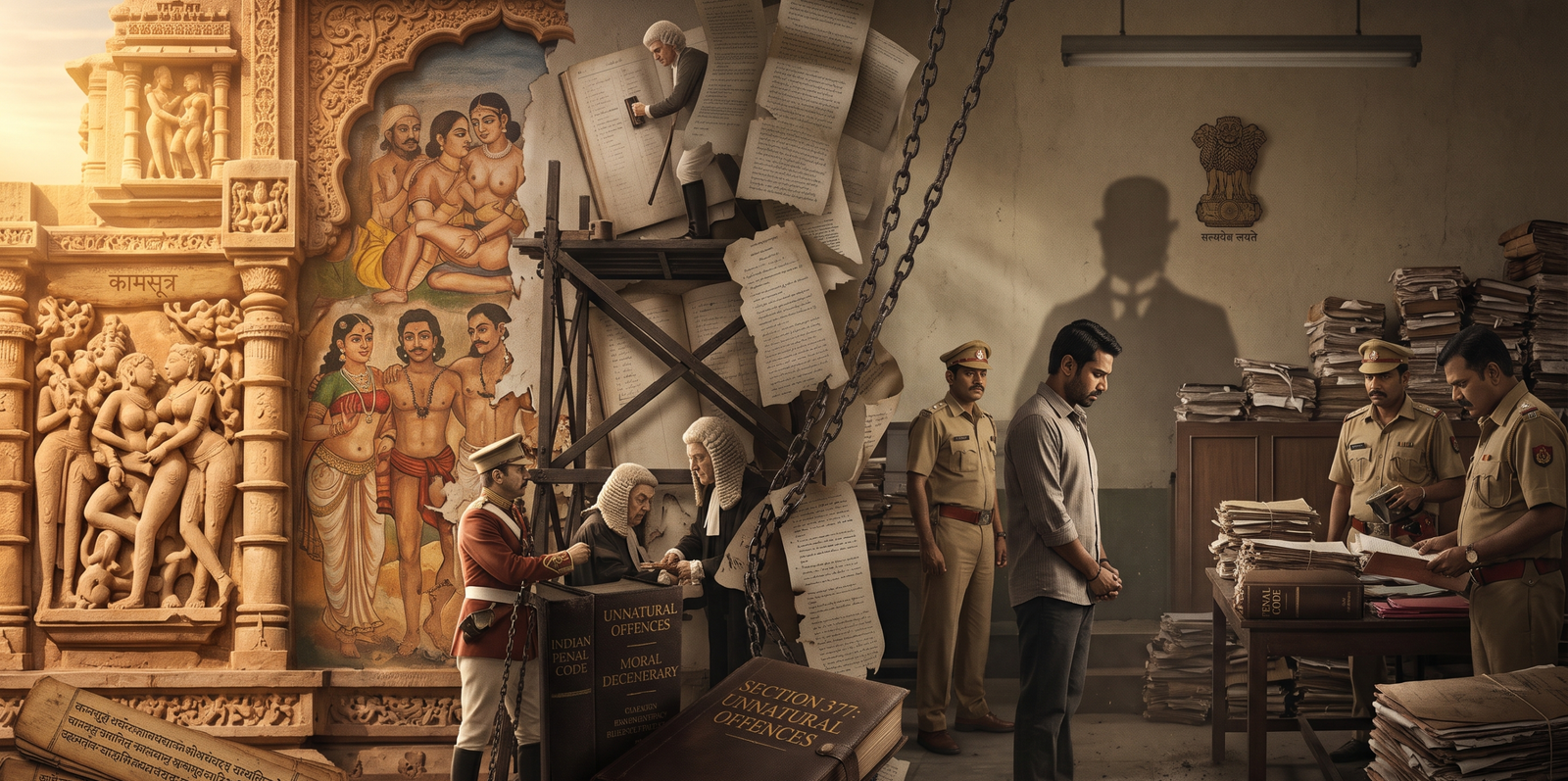
Raghav’s story is about more than sexual orientation. It is about how laws written in another century, by another people, for another purpose, can reach into an Indian bedroom long after the people who wrote them have left.
Raghav is a composite.
The core question
It has become common, in India and abroad, to say that the British brought sexual shame to a once-uninhibited land, the land of the Kamasutra and Khajuraho. The fifth essay in this series showed why that story is too simple: the lawgivers, the physicians who prized semen and the guardians of women’s chastity were Indian, and some were writing two thousand years before any Englishman arrived.
So the honest question is narrower. What did colonial rule add to the shame that already existed, and what did independent India choose to keep? This essay argues that colonialism added three things: new laws that turned private conduct into crime; a new public language of respectability; and a political wound, the charge that Indian men were effeminate and therefore fit to be ruled.
A note on evidence: the laws, dates and court rulings below are established history. Claims about how colonial history shapes men’s inner lives today are interpretations, drawn mainly from historians and from the psychologist Ashis Nandy, and are labelled as such.

Victorian law arrives
The Indian Penal Code was drafted by a commission under Thomas Babington Macaulay in the 1830s and finally enacted in 1860, in the aftermath of the 1857 uprising (Indian Penal Code). Among its provisions was Section 377, modelled on England’s Buggery Act of 1533, which criminalised “carnal intercourse against the order of nature” (Section 377). The phrase was never defined. In principle it could reach any non-procreative sex, between any two people; in practice it became a weapon against men who loved men, and an instrument of police blackmail.
Section 377 mattered far beyond India. Human Rights Watch found that it was the first colonial sodomy law built into a penal code, and that it became the model for laws imposed across Asia, Africa and the Pacific; by its count, more than half of the world’s remaining sodomy laws were British colonial relics. The British introduced such laws, the report concluded, because they regarded the cultures they had conquered as morally lax (Human Rights Watch, This Alien Legacy; summary).
The same Victorian morality shaped how the state treated women who sold sex. The Cantonment Act of 1864 required the registration and medical inspection of women who served British soldiers (Prostitution in colonial India). The Indian Contagious Diseases Act of 1868 extended the system, with compulsory registration, punishment for unregistered women and confinement in “lock hospitals” (Contagious Diseases Acts in Bombay). Women were examined, detained and blamed; the soldiers who paid them were treated as victims of disease rather than participants in its spread. When the Act was repealed in 1888, a new Cantonment Act quickly restored much of the same regime (Legg, Nottingham).
Obscenity law came later. Macaulay’s original draft barely mentioned it; Section 292 was added in 1925 to implement an international convention on obscene publications, and the colonial-era English test for obscenity, which judged material by its effect on the most susceptible reader, continued to guide Indian courts well after independence (SCC Online). Its successor, Section 294 of the Bharatiya Nyaya Sanhita, remains in force (Pornography in India).
Not every colonial sex law was repressive. In 1889, Phulmoni Dasi, a Bengali girl of about ten or eleven, died after intercourse with her husband, a man roughly three times her age. Two years later the Age of Consent Act raised the age of consent for girls, married or unmarried, from ten to twelve. Bal Gangadhar Tilak led the opposition, arguing not for child marriage but that a foreign government had no right to legislate Hindu domestic custom (Age of Consent Act; Phulmoni Dasi case). The episode shows how quickly questions of sex in colonial India became questions of national pride, and how the bodies of women and girls became the ground on which men fought over sovereignty.
The effeminate native
Laws were only one channel. The other was a story the British told about Indian men, and eventually got many Indian men to believe.
From the early nineteenth century, British writers, including the historian James Mill and Macaulay himself, described Bengali men in particular as passive, physically frail and effeminate; a bishop touring India in the 1820s reported that Bengalis were regarded as the greatest cowards in the country (review of colonial representations). The historian Mrinalini Sinha has shown how, by the late nineteenth century, two opposed figures, the “manly Englishman” and the “effeminate Bengali”, had become central to colonial politics. They shaped arguments over whether Indian judges could try Europeans, whether Indians could serve as volunteer soldiers, whether they could enter the higher civil service, and how the Age of Consent should be legislated (Sinha, Colonial Masculinity; book summary). The logic was simple and brutal: real men rule; men who are not real men must be ruled.
After 1857 the logic was written into the army. Recruitment shifted towards so-called “martial races”, such as Sikhs, Gurkhas, Dogras, Rajputs and Pathans, while groups deemed unwarlike were sidelined. One study reports that in the First World War, Bengal supplied about 7,000 combatants against nearly 350,000 from Punjab (Bengali masculinity in the First World War). Whole communities were officially classified as more or less manly, and careers, pensions and prestige followed the classification.
The insult landed in a culture that, as earlier essays showed, already tied a man’s worth to his potency and his semen. Colonialism fused those private anxieties with a public, political one. To be weak in body became a sign of a weak nation; to be a weak nation became a reason to doubt one’s own body. The word napunsak, impotent, has remained a political insult in Indian public life, hurled at leaders and governments accused of weakness, a small reminder of how closely sexual and national potency became entwined.
In the bedroom, the legacy is a manhood that must be constantly proven and is never quite secure: the same fragile, performance-anchored masculinity the series has traced through performance anxiety and the dread of being measured, now with a historical charge attached. A man who cannot perform does not merely disappoint his wife. Somewhere beneath awareness, he confirms an old accusation.
The intimate enemy
The most influential account of what this did to Indian minds came from the political psychologist Ashis Nandy, in The Intimate Enemy (1983). Nandy argued that colonialism is not only a political and economic system but a psychological one, and that it can live on in the culture and psyche of the colonised long after the rulers leave (book summary; Ashis Nandy).
The interpretation. At the heart of Nandy’s argument is what he called a “homology between sexual and political dominance”: the colonisers came to see their rule over India as the rule of masculinity over femininity, of adult over child (Nandy, 1983, preface and first essay). Nandy noted that this idea was not central in the early, more aristocratic decades of British rule; it hardened as Victorian middle-class values took over.
Indian culture, Nandy pointed out, had long recognised three states: purushatva (the essence of masculinity), naritva (the essence of femininity) and klibatva (an androgynous or in-between state), and had often honoured androgyny in its gods, from Ardhanarishvara, half Shiva and half Parvati, to the gentle, playful Krishna. Under colonialism these states were pulled apart into a hierarchy, and any androgyny came to be seen as a betrayal of manhood (discussion of Nandy). The colonised elite, wanting to prove itself, increasingly measured Indian manhood by the coloniser’s yardstick: hardness, aggression, dominance.
Psychoanalysts have a term for this: identification with the aggressor. In plain language, it means adopting the bully’s view of yourself, and then trying to become more like the bully to escape his contempt. The man who has done this despises in himself whatever the bully called weak, including tenderness, gentleness, emotional openness and, in the bedroom, any need that cannot be expressed as performance.
What has been measured. Psychologists have tried to measure the residue of colonial rule as “colonial mentality”: an internalised belief that one’s own culture is inferior to the coloniser’s. In studies of Filipino Americans and young Ghanaian adults, higher colonial mentality scores went with lower self-esteem and more anxiety and depression (David & Okazaki, 2006; Utsey et al., Ghana). A version adapted for Asian Indians in the United States, with British colonialism in mind, also found links with depressive symptoms (colonial mentality among Asian Indians). None of these studies examines sexuality directly. They do suggest that colonial history is not just a matter for textbooks, but something people can carry, measurably, in their sense of themselves.
In the bedroom, Nandy’s reading suggests why many Indian men experience sex as a test of hardness rather than an exchange of warmth, and why gentleness, slowness or receptivity can feel unmanly. It also helps explain a curious double standard: a culture that worships Krishna’s playfulness and Ardhanarishvara’s union of male and female, yet often treats a tender or sexually responsive husband as less of a man.
Nationalist answers: muscle and celibacy
Indian nationalists did not accept the charge of effeminacy quietly. Broadly, they answered it in two ways, and both still shape Indian manhood.
Become harder. The first answer was physical. Swami Vivekananda told young Indians that they must first become strong, and that religion could come afterwards; in one of his most quoted lines, he said they would be nearer to heaven through football than through study of the Gita, and would understand Krishna better with stronger muscles (Vivekananda, Lectures from Colombo to Almora, quoted). Gymnasiums, wrestling akharas and physical-culture societies flourished as patriotic projects. The message was that the nation’s weakness lived in its men’s bodies, and could be trained out of them.
Become purer. The second answer was ascetic, and its great exemplar was Gandhi. In 1906 he took a vow of brahmacharya, lifelong celibacy, and he came to see sexual self-control as a source of moral and political power (Open magazine). The anthropologist Joseph Alter has shown how Gandhi fused personal restraint with national purpose, translating the renouncer’s self-mastery into nationalist politics (Alter, Journal of Asian Studies).
In his last years Gandhi went further. From late 1946, during the communal violence in Noakhali, he had young women, including his grandniece Manu, then a teenager, sleep beside him, sometimes unclothed, as “experiments” to test his celibacy. Close associates objected and some left his service; Gandhi refused to stop (Open magazine; Lelyveld’s biography, as reviewed). Historians still argue over how to understand these episodes. Many readers today see in them a powerful old man using young women in his care for his own spiritual project, whatever his intentions.
Nandy read Gandhi more generously. In his view Gandhi’s real achievement was to refuse the colonial equation of manhood with aggression: he made non-violence, endurance and qualities usually coded as feminine into sources of power, and in doing so offered Indians a way out of competing with the coloniser on the coloniser’s terms (Nandy, 1983; summary).
What both answers share. The muscular and the ascetic paths look opposite, but they rest on the same assumption: that a man’s strength is a finite store, that sexual desire threatens it, and that the nation’s fate depends on how well men guard it. Readers of the earlier essays will recognise the semen economy of Ayurveda and Dhat syndrome, now enlisted in the service of national revival.
In the bedroom, the modern Indian man inherits both commands at once: be hard, and be pure. His heroes are the muscleman and the renouncer. What neither tradition offered him was a model of a man who is strong and tender, sexual and respectful, who can enjoy his wife’s body without feeling that he is spending something he should have saved.
Respectability: how the erotic went underground
It would be too simple to say that the British imposed prudery on a sexually open India. Much of the work was done by Indians themselves, especially by a new English-educated middle class that wanted to prove it was as civilised and respectable as its rulers.
The clearest example is the fate of the devadasis, women dedicated to temples who were often accomplished dancers and musicians, and whose lives included relationships with patrons outside marriage. In 1892 the newly formed Madras Hindu Social Reform Association began campaigning against the tradition (Dancing Through Laws). The “anti-nautch” movement that followed recast devadasis as fallen and diseased women, and by the 1920s many had been pushed out of their homes and into rehabilitation centres (Oberlin dance history). The campaign was led in the legislature by Dr Muthulakshmi Reddy, herself the daughter of a devadasi mother, and culminated in the Madras Devadasis (Prevention of Dedication) Act of 1947, which outlawed dedication and public dancing by devadasis (Madras Devadasis Act).
The reformers had real cause: the system did expose many girls, mostly from lower castes, to exploitation. But the cost was the near-erasure of a living erotic and artistic culture. The dance itself was rescued by being renamed “Bharatanatyam” in the 1930s and reshaped for respectable, largely upper-caste performers, its stigma lifting only after the 1947 Act (E. Krishna Iyer). The previous essays noted a similar fate for Muddupalani’s erotic Telugu poem Radhika Santawanam, banned in 1911.
There is a bitter irony in what happened to India’s most famous erotic text at the same time. The English translation of the Kamasutra by Richard Burton and Forster Arbuthnot was printed privately in 1883 under the name of a fictitious “Kama Shastra Society”, to get around Britain’s obscenity laws (Kama Shastra Society). Many educated Indians would later encounter their own erotic heritage through Western editions, often with embarrassment.
In the bedroom, respectability left a clear division of labour. Desire, skill and pleasure became associated with women outside respectable society; the good wife was expected to be modest, uninstructed and sexually passive. Men learned about sex from rumour, pornography or sex workers, and brought that education home to wives who had been taught nothing. The split between the respected and the desired woman, traced psychologically in the previous essay, was here built into social institutions.
Long shadows: what independent India kept
The British left in 1947. Much of their sexual law, and the respectability that grew around it, stayed. Three examples show how long the shadow has been.
Section 377. In 2009 the Delhi High Court read down Section 377 to exclude consensual adult sex. In December 2013 the Supreme Court reversed that ruling, holding that only Parliament could change the law (Supreme Court Observer). In September 2018, in Navtej Singh Johar v. Union of India, a five-judge bench unanimously struck down the law insofar as it criminalised consensual sex between adults, while keeping it for non-consensual acts (LGBTQ rights in India). Throughout the litigation, the law’s defenders described it as a guardian of Indian values; Human Rights Watch’s history suggests the opposite, that it was the homophobic law, not same-sex desire, that was imported (Human Rights Watch). When the Bharatiya Nyaya Sanhita replaced the Penal Code in July 2024, Section 377 disappeared entirely. Because the new rape law recognises only men as perpetrators and women as victims, men and transgender people lost the provision that had been used to prosecute sexual assault against them (Rape in India).
The marital rape exception. Since Macaulay’s code, Indian law has said that sex by a husband with his wife, whatever her wishes, is not rape, apart from age limits that have risen over time. The exception was carried almost word for word into Section 63 of the new code, with the age threshold now set at eighteen (Prime Legal; Section 63). In 2022 a Delhi High Court bench split on the question, one judge calling it tragic that a married woman’s call for justice remained unheard 162 years after the Penal Code was enacted (Daily Pioneer). On 9 September 2026 a Supreme Court bench led by Chief Justice Surya Kant agreed to examine the exception’s constitutional validity and listed the petitions for final hearing; as of the latest reports, it had not ruled (ANI; Lawful Legal).
Sex education. In 2005 the central government launched the Adolescence Education Programme, prompted largely by the HIV epidemic. By 2007 several states, including Gujarat, Madhya Pradesh, Maharashtra, Karnataka, Kerala, Rajasthan, Chhattisgarh and Goa, had rejected or suspended it, and in 2009 a Rajya Sabha committee opposed school sex education outright, warning that it would promote promiscuity (PLOS ONE). A revised curriculum dropped phrases such as “sexual intercourse” (Hindu College Gazette). The objection was framed as defending Indian culture from Western influence. The shame being defended was, in large part, a Victorian inheritance.
Across all three, the pattern is the same: rules introduced or hardened under colonial rule were later defended as authentically Indian, and the defence of “culture” became the main obstacle to change.
How it shows up in the bedroom
History rarely announces itself in a marriage. It arrives as habits, silences and assumptions that feel like nature. Five of them trace back, at least in part, to the period this essay describes.
Sex as a test of hardness. The colonial charge of effeminacy, and the nationalist effort to answer it, left many men treating sex as proof of strength. Erection becomes a verdict on manhood, and its failure feels like a public humiliation even in a private room.
Sex as spending. Both the muscular and the ascetic nationalisms taught that vigour is a store to be protected. Men who absorbed that lesson may feel drained, guilty or weakened after sex, and may rush or avoid it.
An uninstructed bride and a self-taught groom. Respectability and the long resistance to sex education mean that many couples arrive at marriage knowing little about bodies, pleasure or consent. Men fill the gap with pornography and peer rumour; women are often given nothing. The first night becomes an exam neither has studied for.
No vocabulary of refusal. For more than 160 years, Indian law has said that a wife’s consent is not required for sex with her husband. Most husbands never think about the law. But a culture in which a wife’s “no” has no legal meaning is also one in which her “yes” is hard to read. Men lose the chance to know whether they are wanted, which is one of the most powerful aphrodisiacs there is.
Hidden lives. For gay and bisexual men like Raghav, a century and a half of criminalisation pushed many into marriages with women. Their wives often carry the cost in silence, blaming themselves for a coldness they cannot understand. Decriminalisation in 2018 changed the law, not the families, and many such marriages continue.
For NRI readers, these patterns do not stay behind at the airport. Research on colonial mentality among Asian Indians in the United States suggests that this inherited sense of inferiority can persist among Indians living abroad, with measurable links to low mood.
Counterpoints and limits
Pre-colonial India was no sexual paradise. Child marriage, the guardianship of women, ritual impurity attached to sex, and the semen economy were all Indian long before 1757. Colonialism added layers to an existing structure of control; it did not invent the structure. Any account that blames the British for everything flatters the past and excuses the present.
Colonial law also protected. The abolition of sati in 1829, the Widow Remarriage Act of 1856 and the Age of Consent Act of 1891 were colonial laws that saved or improved women’s lives, often after long campaigns by Indian reformers such as Ram Mohan Roy, Ishwar Chandra Vidyasagar and Behramji Malabari. The same state that criminalised love between men also, at times, limited what husbands could do to child brides.
Indians made choices. The anti-nautch campaign, the respectability of the new middle class, the rejection of sex education and the seventy-one years during which independent India kept Section 377 were Indian decisions. Colonial history explains the origin of these rules; it cannot carry responsibility for keeping them.
“Colonial” can become a political weapon. The colonial label is used in two opposite ways: by those who call homosexuality a Western import, and by those who imagine a golden age of uninhibited Indian sexuality before the British. Both distort the record. The historical evidence supports neither a pure indigenous tolerance nor a pure indigenous repression.
The psychological claims are interpretive. Nandy’s reading of colonial psychology is influential but untestable in any direct way, and research on colonial mentality has mostly been done outside India. It is reasonable to think colonial history shapes how Indian men feel about their bodies; it has not been measured.
The impact was uneven. Colonial rule bore down differently on Bengali clerks and Punjabi soldiers, on urban elites and Adivasi villages, on princely states and directly ruled provinces. “Colonial masculinity” was first a story about particular classes and regions, and its reach into the lives of most rural Indians is far less documented.
What it means
For men. Some of what feels like your private failure is borrowed. The idea that an erection is a referendum on your manhood, that semen is strength to be hoarded, that gentleness is weakness, that sex is something you take rather than something you are invited into: these ideas have a history, and some of that history was written by people who wanted to prove you were unfit to govern yourself. Knowing that does not cure anything. It can, though, loosen the grip of a shame that was never really yours.
For couples. Many couples inherit a silence they did not choose. Breaking it can start small: learning together what neither was taught, naming what each of you finds pleasurable, and making room for either partner to say no without it becoming a crisis. A “yes” means more when “no” is possible.
For gay and bisexual men in heterosexual marriages, and their wives. There is no simple path, and no one outside a marriage should prescribe one. But individual counselling with a therapist who is informed about sexuality and sexual orientation can help a man understand his options without panic, and wives deserve support too, not only explanations.
For parents and schools. Sex education does not cause promiscuity; a review of 83 programmes worldwide found that they reduced young people’s risky sexual behaviour (as summarised in an Indian school study). Refusing it in the name of Indian culture often means defending a Victorian prudery against India’s own more candid traditions.
For clinicians and policymakers. When a man presents with sexual difficulty, his beliefs about strength, semen and manliness are part of the clinical picture, not background noise. And laws that still treat consent in marriage as irrelevant shape the sexual culture that clinicians later have to treat.
Key takeaways
- Colonialism did not invent Indian sexual shame, but it added new laws, a new language of respectability and a political wound to men’s sense of themselves.
- Section 377, enacted in 1860, became the model for sodomy laws across the British Empire; India struck it down for consenting adults only in 2018.
- The British portrayed Indian men, especially Bengalis, as effeminate, and used the charge to justify rule; recruitment by “martial races” turned manliness into official policy.
- Ashis Nandy argued that colonial rule equated power with masculinity, pushing Indian men to adopt the coloniser’s hard, aggressive model of manhood and to devalue androgyny their own traditions honoured. This is an interpretation, not a measured finding.
- Nationalists answered with muscle and celibacy, both resting on the belief that sexual desire drains a man’s strength.
- Indian reformers helped drive the erotic underground, from the anti-nautch campaign to the 1947 Devadasi Act.
- Independent India kept much of the inheritance: the marital rape exception survives in Section 63 of the new criminal code and is before the Supreme Court, and school sex education still faces resistance.
- Some of the shame men feel in bed is historical, not personal, and recognising its origins can make it easier to set down.
Sources and further reading
Colonial law
- Indian Penal Code
- Section 377
- Human Rights Watch, This Alien Legacy (2008)
- British sodomy laws linger in former colonies
- Human Rights Watch, India: sodomy laws perpetuate colonial prejudices
- Prostitution in colonial India
- Contagious Diseases Acts and lock hospitals in colonial Bombay
- Legg, Geographies of prostitution regulation in British India
- Law of obscenity in India, SCC Online
- Pornography in India
- Age of Consent Act, 1891
- Phulmoni Dasi case
Masculinity and colonial psychology
- Sinha, Colonial Masculinity (Manchester University Press)
- Colonial Masculinity, book description
- Colonial representations of Bengali men
- Bengali masculinity and the First World War
- Nandy, The Intimate Enemy (1983), preface and first essay
- The Intimate Enemy, summary and reviews
- The psychology of colonialism: sex, age and ideology
- David & Okazaki, Colonial Mentality Scale (2006)
- Utsey et al., internalised colonialism in Ghana
- Colonial mentality and depressive symptoms among Asian Indians in the US
Nationalism, celibacy and respectability
- Vivekananda on football and the Gita
- Alter, Celibacy, sexuality and the transformation of gender into nationalism
- Gandhi’s experiments and his associates, Open magazine
- Review of Lelyveld’s Great Soul
- Dancing Through Laws: temple dance regulation
- Social reform and the disenfranchisement of devadasis
- Madras Devadasis (Prevention of Dedication) Act, 1947
- E. Krishna Iyer and the renaming of Bharatanatyam
- Kama Shastra Society
Independent India
- Supreme Court Observer, Navtej Singh Johar
- LGBTQ rights in India
- Rape in India
- Section 63 of the Bharatiya Nyaya Sanhita
- Supreme Court and the marital rape exception, Prime Legal
- SC to examine marital rape exception, ANI (September 2026)
- Marital rape debate, Lawful Legal
- Delhi High Court split verdict, Daily Pioneer
- Youth in India ready for sex education?, PLOS ONE
- Adolescent sexuality in India, Hindu College Gazette
- Students’ views on sex education in India
Disclaimer: This content is for general information only and does not replace professional medical advice. Asmidev is not responsible for any diagnosis made based on this content, nor does it endorse or take responsibility for external websites or products mentioned. Always consult a qualified healthcare professional for health-related concerns. This article was created through a human–AI collaboration. The ideas and direction come from the author’s research, with AI used only to assist in organizing information and refining expression, while cross-checking against established scientific literature.


