

The Silent Bedroom · Article 11 of 18
What to tell Aarav
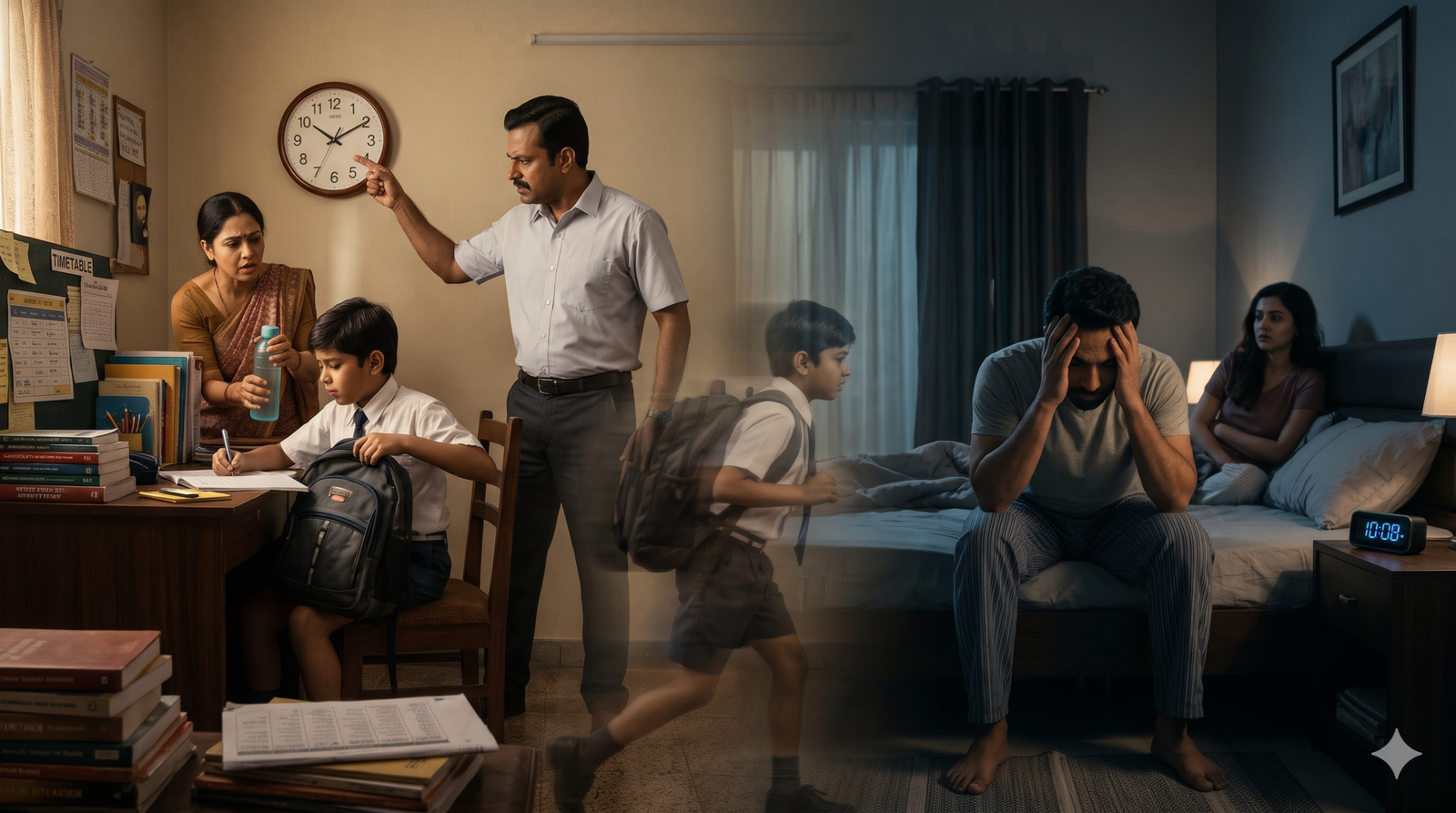
Karthik is thirty-eight, an engineer in Chennai, and the father of a seven-year-old boy named Aarav. Last month Aarav asked, at the dinner table, how babies get out of their mothers’ stomachs. Karthik’s wife laughed and changed the subject. Karthik said nothing, and has been thinking about it ever since.
Nobody ever told Karthik anything. His father was a stern, distant man who beat him with a belt for poor marks and never once spoke to him about his body. When he woke at thirteen to find his sheets wet, he was terrified that he was ill; an older boy at school explained, with relish, that he was losing his strength. He learned about sex from a pornographic magazine passed around a hostel, and later from his phone. Through his teens he prepared for engineering entrance exams at a coaching centre where the day began at six and every test was ranked. He learned to be fast at everything.
Karthik has struggled with premature ejaculation for most of his married life. Only recently, in a few sessions with a therapist, has he begun to wonder whether his boyhood had something to do with it: the fear, the silence, the hurry. And now he has a son, and a question at the dinner table, and he does not want Aarav to learn about his body the way he did.
Karthik and Aarav are composites.
The core question
The two previous essays looked at the clock men carry in their heads and the crowded, hierarchical homes in which they have sex. This one goes back further, to boyhood, and asks a question many men like Karthik eventually ask themselves: did the way I was raised make me like this?
The answer offered here is careful. Lifelong premature ejaculation has strong biological roots, and no parenting style causes it. But the anxiety that surrounds sex, the shame that keeps men silent, the habit of hurrying, the inability to name feelings, and the conviction that manhood must be proved are all learned, and they are learned early. Many Indian boys grow up with a particular combination of experiences: silence about their bodies, strict and sometimes violent discipline, an expectation that boys do not cry, an unrelenting race for marks and rank, and, for a disturbing number, sexual harm that nobody acknowledges. Each of these leaves traces that can reappear decades later in bed.
The evidence is uneven. Figures on what Indian adolescents know about sex, on corporal punishment and on the sexual abuse of boys come from large surveys and are reasonably solid. The link between childhood sexual abuse and adult sexual difficulties has been shown in large population studies, though mostly outside India. The broader argument, that a fearful, silent, competitive boyhood prepares a man for anxious, hurried sex, is an interpretation that draws these findings together. It also points to something hopeful: what is learned in boyhood can be taught differently to the next generation.
The silence at home
Most Indian boys go through puberty without anyone explaining it. The clearest evidence comes from the Population Council’s large UDAYA study of adolescents in Uttar Pradesh and Bihar. In Bihar, only 15% of younger adolescent boys said family members had been a source of information about puberty, against 38% of girls. Boys talked less to their parents about almost everything: only 37% of boys had discussed even their friends with their mother in the previous year, compared with 72 to 77% of girls. The study concluded that adolescents’ awareness of sexual and reproductive matters was limited, and that parents, though often named as the preferred source, rarely took on the role (UDAYA, Bihar). Into the gap come friends and, increasingly, pornography; in the UDAYA data, about 12% of adolescent boys reported exposure to pornography, against 2% of girls (PLOS ONE).
The consequences are easiest to see in the most ordinary event of male puberty, the first wet dream. A 2026 scoping review of the research found that nocturnal emissions are nearly universal, affecting 70 to 90% of boys, and typically begin at around 13 or 14. It also found that misconceptions remain widespread, particularly in South Asia, where nocturnal emissions sit at the heart of Dhat syndrome (Sexual Medicine Reviews, 2026). A boy who wakes to find his sheets wet, and who has been told nothing except that semen is precious strength, may conclude that something has gone terribly wrong with his body. Karthik did. Many men in Indian sexual health clinics trace their anxieties to exactly this moment.
The silence teaches several lessons at once. It teaches that the body is a source of danger and embarrassment. It teaches that questions about sex cannot be asked of anyone trustworthy. And it teaches that whatever a boy learns will come from the least reliable sources available: boasting peers, rumour and videos designed to excite rather than inform. The boy who grows into a husband anxious about timing, size or semen is often the same boy who once had nobody to ask.
The disciplined body
For generations, Indian parents and teachers have believed that a boy is made into a man through firmness, and that firmness sometimes means the stick. The scale of this is striking. The Ministry of Women and Child Development’s national study of child abuse, published in 2007, found that 69% of children reported physical abuse, and that boys made up more than half of those affected; two out of three school-going children reported corporal punishment (Child abuse in India, review; ISTSS summary). A later survey by the National Commission for Protection of Child Rights, covering seven states, found that 99.7% of children reported some form of punishment at school; 75% had been caned and 69% slapped (Chandra, citing NCPCR 2012). Among eight-year-olds in one study, corporal punishment was more common for boys than girls, 83% against 73% (Vikaspedia).
Alongside the stick comes a code of feeling. Indian boys learn early that they are not to cry, not to show fear and not to complain; the old film line mard ko dard nahi hota, a real man feels no pain, survives as everyday advice. Fathers in particular are often present as authority and absent as comfort, as the sixth essay described. Many men reach adulthood with a body that has learned to brace for blows and a vocabulary with no words for fear, shame or need.
What has been measured. Research on how childhood adversity affects adult male sexuality is still thin, but it points in a consistent direction. In a study of 301 young men, occasional premature ejaculation and low desire were common, and long-lasting difficult relationships with parents and other attachment figures predicted later sexual problems more strongly than childhood sexual abuse did (Kinzl et al., 1996). In a Turkish study, men with erectile dysfunction, with or without premature ejaculation, reported significantly more childhood physical abuse than men without sexual problems (Turkish study, 2024). The fourth essay noted Indian studies linking adverse childhood experiences to adult depression and anxiety, both of which travel with premature ejaculation.
The interpretation. A child who is regularly hit learns to live on alert, scanning faces for anger and preparing to flinch. That readiness is the work of the body’s alarm system, the same system that, as the third essay explained, speeds ejaculation and undermines erection. A man raised this way may carry a nervous system that switches into alarm more readily than most, and he may experience the vulnerability of sex, being seen, being judged, being close, as a kind of exposure. Add a childhood rule against showing fear, and he can neither calm the alarm nor speak about it. What remains is to get through the moment quickly.
The race
The second great project of many Indian boyhoods is achievement. A son is expected to secure the family’s future, and from an early age his days are organised around marks, ranks, tuition and entrance examinations. The pressure is not imagined. In a study of higher secondary students in Kolkata, 63.5% reported stress due to academic pressure, 66% said parental pressure for better performance was a source of stress, and 81.6% reported examination-related anxiety; academic stress was linked with psychiatric problems (Deb, Strodl & Sun, 2015). At the extreme end, 13,892 students died by suicide in India in 2023, 8.1% of all suicides, and the number has risen by about 73% over a decade (Careers360, citing NCRB).
The race teaches lessons that go beyond the classroom. It teaches that worth is measured, ranked and compared. It teaches that speed is a virtue: the timed test, the shortcut method, the coaching centre’s promise to get there first. It teaches that a mistake is not a step in learning but a mark against you, and that the right response to anxiety is to push harder. And because boys bear the heaviest expectations of providing for the family later, it ties their very identity to performance.
The interpretation. It is not hard to see how a boy trained this way approaches sex as a man. Sex becomes another exam: something with a correct answer, a time limit, a score and an examiner. The third essay described how this “performance” frame produces spectatoring and anxiety; the ninth described the stopwatch. A boyhood spent racing teaches the habits that make both more likely. The man who was praised for finishing first, and punished for failing, does not easily learn that in bed there is no prize for speed, no rank, and no one keeping score unless he invents one.
The sixth essay described research showing that manhood is widely experienced as “hard won and easily lost”, something to be proved again and again. In India, much of that proving begins in the examination hall. It continues, for many men, in the bedroom.
Hidden harm
This section deals with the sexual abuse of children. Readers who find the subject difficult may wish to skip to the next heading.
The same 2007 government study found that 53.22% of the children surveyed reported one or more forms of sexual abuse, and that boys made up slightly more than half of those, 52.94% (Indian Journal of Psychiatry, citing the MWCD study). The study used a broad definition that included non-contact forms of abuse, and its figures should be read with that in mind. But the central finding has been confirmed elsewhere: in India, boys are sexually abused at rates comparable to girls, and in some studies higher (ISTSS). Yet the abuse of boys is far less often recognised. A boy may not have words for what happened, may fear that telling will make him less of a man, or may be disbelieved; a qualitative study from an Indian general hospital was titled, simply, “Silence of male child sexual abuse in India” (Indian Journal of Psychiatry). Since 2012, the Protection of Children from Sexual Offences Act has recognised boys as well as girls as victims (POCSO Act), but law reaches only the cases that are reported.
What has been measured. The long-term effects on men’s sexual lives are increasingly clear. In a large population study published in 2026, men who had been sexually abused as children had about three times the odds of erectile difficulties and nearly three times the odds of reduced desire, with the association holding across all age groups (Imanishi et al., Andrology). The Turkish study mentioned above also found higher rates of childhood sexual abuse among men with erectile dysfunction and premature ejaculation. Interestingly, the earlier study of young men found that ongoing difficult relationships with parents mattered even more than abuse (Kinzl et al.), a reminder that the everyday emotional climate of childhood counts as much as single terrible events.
The interpretation. For a man who was abused, sex can carry associations with fear, helplessness, secrecy and shame that he may not consciously connect to the past. Some respond by avoiding intimacy, some by rushing through it, some by numbing themselves. Many have never told anyone, including their wives. Clinicians in India rarely ask men about childhood sexual abuse; when they do, gently and without pressure, it can open the way to help that no tablet provides.
What protects
If a fearful, silent, competitive boyhood can leave traces in a man’s sexual life, the obvious question is what a protective boyhood looks like. The research does not offer a formula, but it points in some clear directions.
The first is security. The sixth essay described a study in which men with lifelong premature ejaculation showed markedly higher attachment anxiety, a chronic fear of losing the people they depend on, than men without it (clinical study). Attachment patterns are formed in childhood and are not destiny, but a boy who grows up confident that he is loved, whatever his marks, carries less of that fear into adult intimacy.
The second is honest talk. A meta-analysis of three decades of research, covering more than 25,000 adolescents, found that sexual communication between parents and teenagers was linked to safer sexual behaviour; the effect was small, strongest for conversations with mothers, and weaker for boys than for girls (Widman et al., 2016), perhaps because boys are the ones parents talk to least. Importantly for Indian parents, who often fear that talking about sex will encourage it, a meta-analysis of 31 trials of parent-based sexual health programmes found that they improved communication and condom use and had no effect on when teenagers became sexually active (Santa Maria et al., JAMA Pediatrics).
The third is emotional permission. Boys who are allowed to name fear, sadness and shame, and who see their parents name and manage their own feelings, learn that emotions can be felt without being acted out or hidden. That skill, so ordinary it is easy to overlook, is exactly what a man needs when anxiety rises in bed: the ability to notice it, say it and let it pass rather than racing ahead of it.
The fourth is safety from harm. Discipline without violence, and an adult a boy can tell if someone touches him wrongly, reduce two of the most damaging influences described above.
None of this is exotic. It is simply the opposite of the silence, the stick, the race and the secret.
From boyhood to the bedroom
Drawn together, the threads of this essay can be laid out side by side: five common features of Indian boyhood, and the adult patterns each can feed. The arrows are pathways, not sentences. Most men raised with some of these experiences do not develop sexual problems, and those who do usually have more than one thread at work.

How it shows up in the bedroom
Men rarely connect what happens in bed to what happened in childhood, but clinicians often see the connection in how men talk about their problems.
There is the man who cannot say what he feels. Asked how he felt the last time sex went badly, he describes what happened, not what he felt, or says “tension” and stops. He has never been allowed a vocabulary for fear, so his anxiety can only show itself through his body.
There is the examinee. He describes sex in the language of marks and results: he “failed”, he “did better this time”, he wants to “improve his score”. He monitors himself throughout, exactly the spectatoring that speeds ejaculation and weakens erection.
There is the self-punisher. After a difficult night he berates himself in words that sound remarkably like a strict father or teacher: useless, weak, a disgrace. The inner voice that once accompanied the stick now accompanies the bedroom, and it makes the next attempt more anxious still.
There is the man who flinches from closeness. Intimacy, being seen and held, makes him uneasy in ways he cannot explain, and he rushes through sex partly to escape that unease. For some of these men there is a history of harm they have never told anyone.
And there is the man who repeats the silence. Like Karthik at the dinner table, he does not know what to say to his own son, and so, unless he decides otherwise, he says nothing, and the cycle begins again.
The hopeful finding, repeatedly reported by therapists, is that simply making the connection can bring relief. A man who understands that his alarm, his silence or his self-punishment were learned in particular circumstances can begin to see them as habits rather than defects, and habits can change.
Counterpoints and limits
The biggest limit is that almost none of this has been studied directly in Indian men. We have good Indian data on what adolescents know, on corporal punishment and on the sexual abuse of children, and some international data linking childhood adversity to adult sexual difficulties. What we do not have is a study that follows Indian boys into adulthood and measures their sexual function. The pathways in this essay are reasoned inferences, not demonstrated causes.
Much of the evidence on childhood is also retrospective. When adults with sexual problems are asked about their childhoods, they may remember differently from those without problems, or search for explanations in the past. That does not make their memories false, but it calls for caution.
The same childhood experiences lead to very different adult lives. Many men who were beaten, kept in ignorance and pushed through brutal examinations have satisfying sexual lives. Temperament, later relationships, a supportive partner and plain luck all intervene. Equally, lifelong premature ejaculation can occur in men raised with great warmth and openness, because its roots are largely biological.
Parents should not read this essay as an indictment. Most Indian parents who used the stick or stayed silent were doing what they had been taught was right, often under great pressure of their own. The point is not to blame the previous generation but to give the next one something better.
Finally, Indian childhoods are changing. Corporal punishment in schools has been banned since 2009, many urban parents now talk more openly with their children, and fathers are slowly becoming more involved. The patterns described here are common, but they are not universal and they are not fixed.
What it means
For parents, the most useful single change is to start talking early and keep talking. Young children can be taught the correct names for their body parts and the simple rule that no one may touch them in ways that make them uncomfortable, and that they can always tell a parent. Before puberty, boys should hear from someone they trust that wet dreams and masturbation are normal and harmless, that semen is not stored strength, and that their bodies are developing exactly as they should. These conversations need not be perfect; the research suggests that their existence matters more than their polish, and that they do not encourage early sex. Fathers have a particular role, because boys hear least from them.
Parents can also raise boys who are allowed to feel. Saying “you look scared” or “that was disappointing” to a son, and accepting the answer, teaches him that emotions can be named and survived. Replacing the stick with calm, consistent limits teaches him that mistakes are survivable too. And praising effort and curiosity rather than rank tells him that his worth does not depend on finishing first.
For schools, age-appropriate sexuality education that includes boys’ experiences of puberty, consent and emotional health, along with a firm end to corporal punishment, would reach the many boys whose parents cannot or will not talk.
For men who recognise their own boyhood here, the past cannot be changed, but its grip can be loosened. Therapy that explores early experiences alongside present sexual difficulties, whether individually or with a partner, can help men see learned patterns for what they are. For men who were sexually abused as boys, specialised trauma-informed help exists and can make a profound difference.
For clinicians, a few gentle questions about childhood belong in any assessment of a man’s sexual difficulties: how sex and the body were spoken about at home, how discipline was handled, what pressures he grew up under, and whether anything happened to him that he has never told anyone.
And for Karthik, there is an answer to give at the dinner table. Babies grow in a special place inside their mothers called the uterus, and come out through an opening between her legs called the vagina. It is a simple sentence. Saying it calmly may be the first step in raising a son who will not have to learn about his body in fear.
Key takeaways
Lifelong premature ejaculation is largely biological and no parenting style causes it, but much of the anxiety, shame and hurry that surround sex for Indian men is learned in boyhood. Most Indian boys go through puberty with little explanation from parents, and nocturnal emissions, which nearly all boys experience, remain surrounded by misconceptions in South Asia. Corporal punishment has been near-universal in Indian homes and schools and falls more heavily on boys, while a code of emotional silence leaves many men without words for fear; childhood adversity, especially difficult relationships with parents, has been linked to adult sexual problems. An unrelenting race for marks teaches boys that worth is measured and speed is a virtue, preparing them to treat sex as an exam. Boys in India are sexually abused at rates comparable to girls, the abuse is rarely acknowledged, and childhood sexual abuse roughly triples the odds of adult erectile difficulties in population data. What protects is security, honest talk about bodies and sex, permission to feel, discipline without violence and an adult a boy can tell; talking to children about sex improves safety without encouraging early sex. These pathways are inferences rather than proven causes, Indian childhoods are changing, and the purpose is not to blame parents but to raise sons who will not have to learn about their bodies in fear.
Sources and further reading
Puberty, silence and sources of information
- UDAYA: Understanding the lives of adolescents and young adults in Bihar, Population Council (2017)
- UDAYA Uttar Pradesh executive summary
- What predicts early sexual debut among unmarried adolescents? UDAYA, PLOS ONE
- Nocturnal emissions or wet dreams: a systematic scoping review, Sexual Medicine Reviews (2026)
Discipline, abuse and adult sexual function
- Child abuse in India, review citing the MWCD 2007 study
- Child abuse and neglect in India: prevalence and policy recommendations, ISTSS
- Chandra, Child abuse and neglect in India, citing NCPCR 2012
- Violence against children in India, Vikaspedia
- Silence of male child sexual abuse in India, Indian Journal of Psychiatry
- Protection of Children from Sexual Offences Act, 2012
- Kinzl et al., Sexual dysfunction in males: significance of adverse childhood experiences (1996)
- Childhood trauma, anxiety and sexual satisfaction in Turkish men with erectile dysfunction
- Imanishi et al., Childhood sexual abuse and erectile difficulties in adult men, Andrology (2026)
Academic pressure
- Deb, Strodl and Sun, Academic stress, parental pressure and anxiety among Indian high school students (2015)
- Student suicides in 2023, Careers360, citing NCRB
What protects
- Attachment and lifelong premature ejaculation, clinical study
- Widman et al., Parent-adolescent sexual communication and safer sex: a meta-analysis, JAMA Pediatrics (2016)
- Santa Maria et al., Parent-based interventions for adolescent sexual health: a meta-analysis, JAMA Pediatrics (2019)
Disclaimer: This content is for general information only and does not replace professional medical advice. Asmidev is not responsible for any diagnosis made based on this content, nor does it endorse or take responsibility for external websites or products mentioned. Always consult a qualified healthcare professional for health-related concerns. This article was created through a human–AI collaboration. The ideas and direction come from the author’s research, with AI used only to assist in organizing information and refining expression, while cross-checking against established scientific literature.


